


While critics of mass migration keep on being labelled as racists, fascists, Islamophobes, and right-wing extremists, the problems associated with immigration can no longer be swept under the carpet. In an ever greater number of European countries, immigration has become one of the main election topics – thanks to social media, we are increasingly hearing about the acts of violence committed by immigrants, even though the mainstream media generally tries to hide and marginalize them. Many European cities are being Islamized, European culture is suffering destruction, and various new norms and values are being imposed upon the European societies. This piece asks is it still possible to halt this process, or are we already hopelessly late in doing so?
Demographic developments: immigrants are dependent on benefits
Jan Latten, professor emeritus of social demography and former chief demographer at Statistics Netherlands (CBS), gives his view on demographic issues: “Over the past eight years, the Dutch population has grown by one million, largely due to immigration. These are often people who bring along cultural norms and values different from ours, and this causes destabilization and friction in the social texture. And it is not just a question of numbers, but of the speed at which these changes are taking place. Society cannot keep up with this pace. The Netherlands has always been a country of immigrants. Be it the Huguenots, Jewish refugees, or guest workers in the 1960s, we have always welcomed people from the outside. But what we see happening now is different. The waves of migration are larger and the culture of migrants is more diverse. This makes integration more difficult and creates tensions in the society. We see this reflected in discussions about religion, engagement in the labour force, social benefits, the housing market, and even who is entitled to what kind of care. There is simply not enough capacity to serve everyone adequately. Such problems accumulate and will ultimately lead to social unrest.”
A distinction must be made between guest students and guest workers or, for example, refugees from Ukraine, who contribute to the labour market and generally return to their country of origin after some time. However, the main asylum seekers in the Netherlands over the last 10 years have come from Syria, Eritrea, Iraq, Afghanistan, Somalia, and other African or Middle Eastern countries. The majority of them are single men aged 15-40.
Immigrants from Africa and the Middle East who are mainly the asylum seekers have a low level of education and are ‘family migrants’, i.e. their family members will later join with them once they have been granted a residence permit. Due to their low level of education and their religious customs or other practices, e.g. regarding the role of women in the family, their participation in the labour market is low and many remain dependent on benefits.
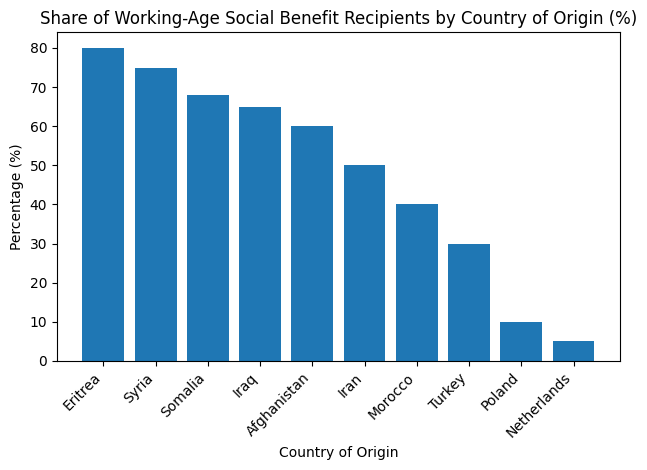
The birth rate amongst the immigrants from Africa and the Middle East is at the same time significantly higher than amongst the Europeans. According to CBS projections, the average is 2.25 compared to 1.56 for the rest of the population. Add to this the fact that immigrants from Islamic countries are overrepresented, and the picture is clear: Muslims account for a large part of the population growth. Islamists, including preachers in Western Europe, make no secret of the fact that demographics are the most important means of achieving a caliphate or a global Islamic society.
Islamists aim for power
In the coming decades, Muslims will be become the majority in an ever increasing number of neighborhoods and cities. There are currently over a million Muslims living in the Netherlands, and according to Jan Latten’s calculations, this number is expected to reach three to four million by 2050. The Islamization of the Netherlands is taking place partly before our very eyes, and in Amsterdam, Rotterdam, The Hague, and Utrecht, as well as in some of the smaller cities, the growth of Islam is clearly visible on the streets. The question is not so much whether Islam will become the dominant religion in the Netherlands, but when it will do so.
There is a noticeable upward trend in the number of Muslim students in European capitals, and it is estimated that Muslim students already make up 52% of students in Brussels, 43% in Amsterdam, and 41% in Vienna.
On May 21 last year, France’s National Security Council discussed a report according to which the Muslim Brotherhood is infiltrating France, spreading political Islam. According to the report, France’s national cohesion is under threat and the Muslim Brotherhood wants to establish political Islam by targeting schools, mosques, and local organizations. The report is also highly critical of the movement’s influence in Belgium, and more specifically in Brussels. For example, it claims that several municipalities in Brussels are under the control of the conservative Islamic movement. Several experts warn that within a few decades, several French municipalities will have fallen into the hands of Islamists. This is already the case in at least five municipalities in Brussels, such as Saint-Josse and Molenbeek. In addition to France and Belgium, the report mentions Austria, Germany, and the United Kingdom.
Islamic traditions in the church: last spring, many Muslims gathered for iftar, the Ramadan evening meal, at the Church of St. John the Baptist in Molenbeek, Brussels. According to the organizers, it was deemed important to bring different cultures together, so as to revive the local community and show Molenbeek in a positive light:
The European Commission has allocated more than €17 million in grants to Islam-related research in recent years, but the aim of the research seems often the promotion of Islam, called the combating of “Islamophobia.” For example, the European Commission allocated €2.5 million to a French study mapping the development of Sharia law, which will run until 2029. Another project, coordinated by Istanbul Bilgi University, received €2.3 million in European funding and studied the rise of “populist” and “Islamophobic” discourse in Europe. Researchers at Ludwig Maximilian University in Munich received €2.3 million to study the role of animals in Islamic philosophy. A six-year, €9.8 million research project focuses on the “European Quran” and is based on the idea that the influence of Islam on European culture has been greatly underestimated, as well as on the conviction that the Quran played an important role in shaping European religious diversity and identity in the Middle Ages and early modern period, and that this is still the case today. The researchers participating in the study have been suspected of having ties to the Muslim Brotherhood.
Sharp rise in crime
No group has as much difficulty integrating as asylum seekers from Africa and the Middle East. They are poorly educated, often dependent on benefits, relatively often involved in crime, and even in their second generation, they tend to remain stuck at a lower level of education.
In addition to school performance and education, integration is closely dependent on culture and cultural distance. According to several large-scale long-term studies, the cultural distance between Africa and the Middle East and the Netherlands is the greatest. Immigrants and their (grand)children perform worse on approximately 25 integration criteria. One of these integration criteria is crime.
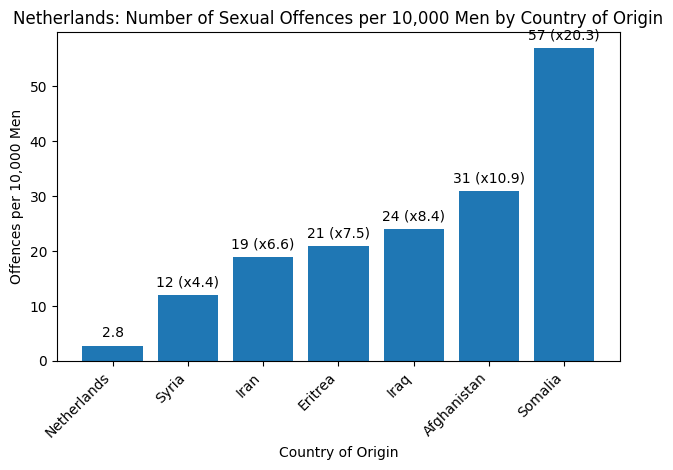
Governments rarely record religion in crime statistics. In Western European countries where statistics are kept, migrants from Muslim countries are overrepresented in crime rates. Dutch asylum seekers are almost four times more likely to be suspects than Dutch nationals. After adjusting for age and gender, this is about twice as frequent. In the Netherlands, men from typical asylum countries such as Somalia, Afghanistan, Iraq, Iran, Eritrea, and Syria commit sexual crimes four to 20 times more often than native Dutch people. Surprisingly, crime rates among the second-generation non-Western immigrants are even higher than among the first-generation immigrants.
We see similar patterns in the United Kingdom and Scandinavia: among certain immigrant groups, especially those from Islamic countries, the level of crime is structurally higher than among the native population. Muslims are also clearly overrepresented among prisoners compared to their share of the population.
Sharia law wanted
This cultural distance is also reflected in political and institutional views.