


Over the past few days, the following topics attracted our attention:
Brussels Calls for Phased Social Media Ban
U.S. Health Secretary to List COVID Vaccine Harms
Russia Forces Hotels to Use the State-Backed App Max
Brussels Calls for Phased Social Media Ban
The European Commission’s special panel has completed a report on protecting children online and establishing a new standard in the digital world. The report recommends a phased approach to digital childhood, in which children under 13 would not have independent access to social media+, with greater autonomy granted as they grow older. The report also emphasizes holding technology companies accountable for making their services safer for minors, according to EU Perspectives.
Commission President Ursula von der Leyen said at a press conference on Monday: “This report comes during a unique window of opportunity. We have heard from parents, educators, experts, and young people themselves. We have heard the experience from partners like Australia, as well as our Member States. Now we need action at European level,” she said, adding that the Commission will carefully review the report and present proposals this fall on how to ensure age-appropriate access to social media+.


More specifically, the report recommends avoiding all types of screens from birth until age 2. Children aged 3 to 5 should use digital devices only for limited periods with an adult present to ensure age-appropriate content. Children aged 6 to 9 should use social media and video games only with parental consent and supervision, with time limits and age-appropriate content. The same applies to ages 10–12, but the report notes this group is particularly vulnerable as online participation grows socially important. In summary, children under 13 should not have independent access to social media+.
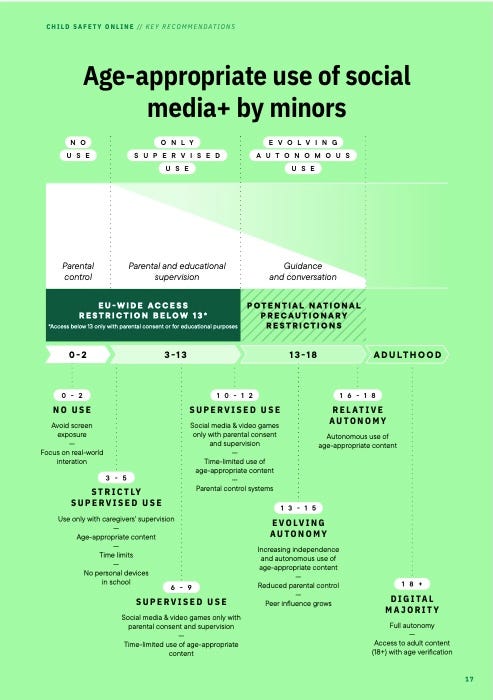
Starting at age 13, children would gradually gain more independence, with direct parental control decreasing. Guidance, dialogue, media literacy, and safer platform design become key. Young people aged 16–18 should use age-appropriate digital services more independently but still need guidance, support, and complaint mechanisms. Full digital independence comes at 18.
The report therefore recommends establishing age restrictions and calls for the safe design of online services. It calls for greater attention to harmful features like infinite scrolling, autoplay, push notifications, and problematic personalized recommendations. It is worth noting that the report addresses the online environment much more broadly than just social media refers to it as “social media+.” The latter covers social media and other digital services that, according to the report, may expose minors to inappropriate content, such as app stores, video platforms, video games, and artificial intelligence.
Von der Leyen presented the report as urgent, noting that young people in Europe spend hours a day on screens. Consequences include sleep disorders, depression, anxiety, cyberbullying, and exposure to harmful material. “It is clear we need age-appropriate restrictions to platforms. This is not about whether children can access social media. It is about whether and when social media can access our children,” she emphasized, explaining that Europe believes children are raised by parents, not algorithms. “To that end, let me be very clear: social media is not a toy. While ultimately it is up to parents to decide when children get their first smartphones, what we already have is a consensus that there needs to be a start date for the age children can join social media,” she noted.
Based on the report, the European Commission hopes to draft common EU-wide rules for a social media minimum age applicable to all member states, which have so far taken varied approaches. France has set the limit at 15, Greece plans restrictions under 15, and Denmark is considering a higher limit with possible parental exceptions. Restrictions are also under consideration in Germany, Austria, Sweden, Spain, and parts of Belgium.
At the same time, critics of age verification and many others (see here, here, here, here, here) have emphasized that if the system requires every European to upload a passport, ID card, or facial scan to multiple private companies, it creates serious privacy and security risks, killing anonymity online. Social media platforms would gain even more information about every European user. According to the report, platforms should not require identity documents or biometric data; instead, a solution should be found that allows age to be verified without disclosing one’s identity or exact date of birth. According to the European Commission, such a solution is the age verification application developed by the Commission, which, however, was hacked within the first few minutes of use.
U.S. Health Secretary to List COVID Vaccine Harms
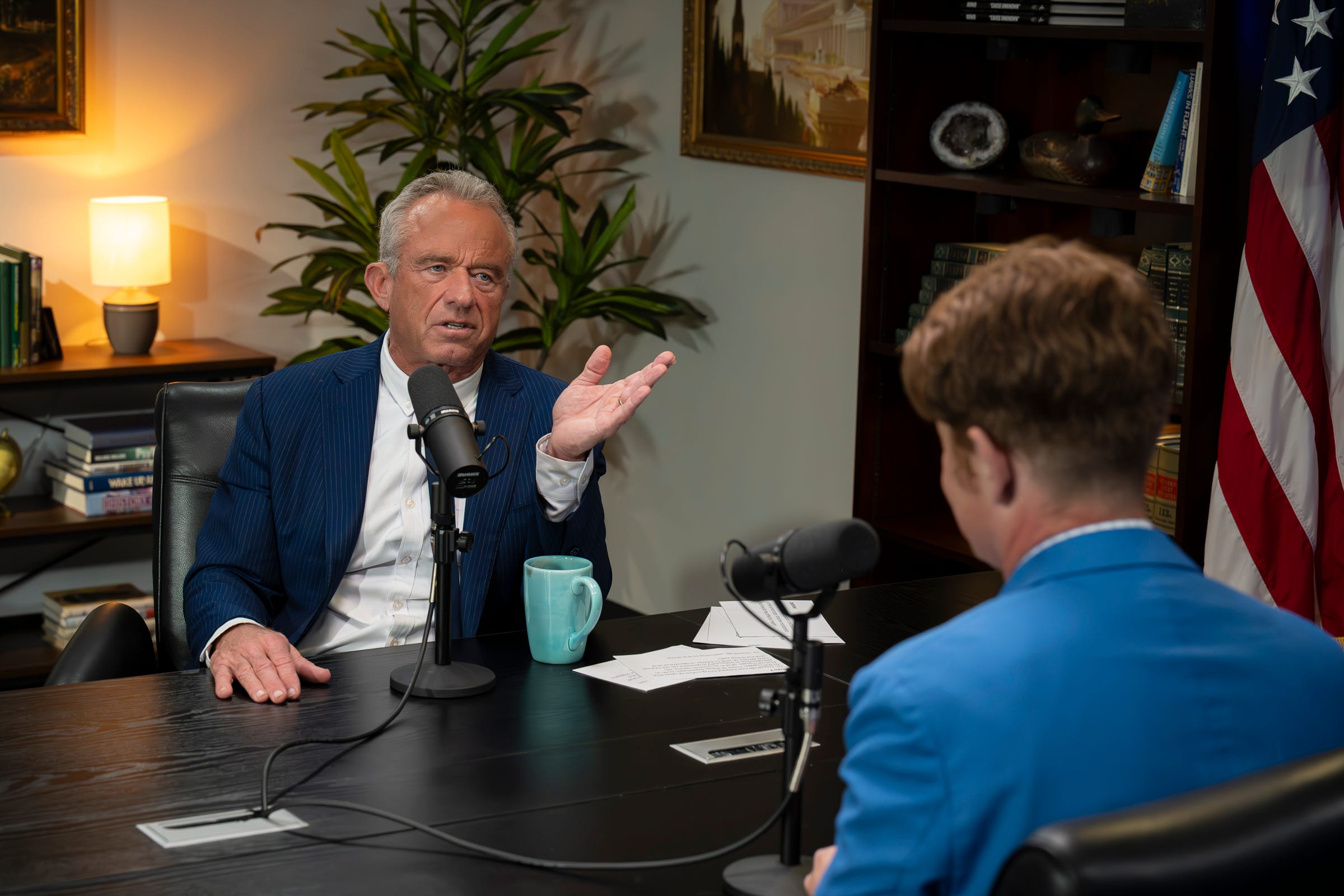
U.S. Health Secretary Robert F. Kennedy Jr. plans to compile a list of health damages caused by COVID-19 vaccines. Health Secretary Robert F. Kennedy Jr., who recently terminated the emergency use authorizations for COVID-19 vaccines, is authorized under related provisions to provide compensation for vaccine-related injuries. Now, the Department of Health and Human Services (HHS) plans to compile a table listing health damages presumed to be caused by COVID-19 countermeasures (such as vaccines) if they occur within a specific timeframe after administration, writes The Epoch Times.
According to HHS, the government would pay compensation for the listed injuries. The table would simplify the claims process, and the ministry hopes it will also reduce the burden of proof for affected individuals. Groups representing people who have suffered health damage from the COVID-19 vaccines doubt whether the list will help those whose compensation claims have been rejected. Vaccine advocates, however, fear that the list will be misused to claim it constitutes proof of a causal link.
Dr. Joel Wallskog, co-director of React19 - an organization supporting people who have suffered health damage - who himself suffers from COVID-19 vaccine-related issues, doubts that such a list would significantly improve the situation. In Wallskog’s assessment, the list may only slightly simplify the process for a relatively small number of people whose injuries, primarily anaphylaxis and myocarditis/pericarditis, are already recognized. However, for those whose claims have been rejected, little is likely to change. Despite this, data from associations representing vaccine-injured individuals, including React19, point to evidence linking other health problems to the vaccines.
Vaccine advocates have also responded. According to Richard Hughes IV, former head of Moderna and an advocate for the American Academy of Pediatrics, the key question is whether the list will spread even more misinformation. Hughes expressed concern that the secretary might add “more speculative or poorly substantiated health conditions” to the list. For example, if it included certain neurological syndromes, POTS/dysautonomia, chronic fatigue syndromes, autoimmune diseases, or theories of sudden cardiac death, it could be used to claim that the government has confirmed a causal link. Note that Hughes also represents organizations that sued the government over changes to the mandatory childhood vaccination schedule.
According to a 2024 report by the U.S. National Academy of Sciences, Engineering, and Medicine, COVID-19 vaccines administered in the U.S. cause myocarditis and shoulder injuries, but evidence is inadequate to definitively link many other health issues to the vaccines. As a result, only around 60 claims for health damage caused by COVID-19 vaccines have been compensated in the U.S. so far (figures vary slightly by reporting date). Almost all involved myocarditis following vaccination. The average compensation has been modest (around $4,000/€3,500), though a few larger payments exist and approximately 99% of claims have been denied.
Russia Forces Hotels to Use the State-Backed App Max
Russian authorities have ordered hotels to use the state-backed Max app when registering guests. In hotels, the requirement takes effect in September. This will likely not be the last sector where Max becomes mandatory, according to The Moscow Times.
The requirement applies to hotels with more than 50 rooms, which must acquire the necessary hardware and train their staff before September 1. It is based on rules introduced on April 1, which allow Russian citizens to check into a hotel using not only a passport but also a driver’s license, biometric data, or the state service portal Gosuslugi. Foreigners must present a physical passport when checking into a hotel. If a guest lacks documents, this does not exempt them from using Max. “I would like to remind you that starting September 1 of this year, if a registered guest does not have a passport, foreign passport, or driver’s license with them, you are required to register them using Max,” emphasized Minister of Economic Development Maxim Reshetnikov.

This is yet another push by the Russian government to adopt Max in as many sectors as possible. The Kremlin’s long-term plan is to turn Max into a super-app that combines private messaging, digital payments, government services, and more. The messaging app Max began to be aggressively promoted in Russia last year, when the Kremlin endorsed it as an alternative to popular messaging apps such as WhatsApp and Telegram. Citizens were persuaded to use Max through both threats and direct coercion, as well as by restricting the functionality of other apps. Now, Max is required to be pre-installed on all smart devices. As a result, users are increasingly forced to adopt Max, as an increasing number of services require it - including government services, education, finance, healthcare, and even transportation, and now hotels.
However, Max has been dogged by a reputation as a surveillance tool from the very beginning. According to critics, the app allows for the surveillance of users; it shares user data, including IP addresses and activity logs, with third parties and government agencies, and all activity within the app is essentially under the watchful eye of the Federal Security Service (FSB).
"Vaccine advocates, however, fear that the list will be misused to claim it constitutes proof of a causal link."
Let's be honest. They don't even want the possibility to be known.