


Over the past few days, the following topics attracted our attention:
Europeans Prioritise Cost of Living – Parliament Focuses on Climate and AI
Portugal Has Banned Burqas and Niqābs in Public Spaces
Musk’s xAI is Taking Users to Court
Europeans Prioritise Cost of Living – Parliament Focuses on Climate and AI
According to the Eurobarometer spring 2026 survey, Europeans see the cost of living, the economy, employment and security as key issues the European Parliament should prioritise. They rate digitalisation, artificial intelligence and gender equality as far less important, even though these feature among the Parliament’s priorities.


A Eurobarometer survey by the European Parliament (April–May 2026, all 27 EU Member States) shows that economic concerns have become Europeans’ top worry in recent years. The cost of living, inflation and rising prices rank highest, with 47 per cent wanting the Parliament to tackle them as a priority. The economy and employment came second (35 per cent), followed by EU defence and security (34 per cent). Public health (30 per cent) and poverty (25 per cent) followed.
Notably, climate change has fallen to a relatively low priority, with only 22 per cent of respondents – less than a quarter – considering it important. It is most frequently cited by Swedes (49 per cent) and Danes (45 per cent). The same applies to gender diversity, which was highlighted by only one in ten people (10 per cent). Only 6 per cent cited religious freedom as important, and 5 per cent the right to asylum. Digitalisation and artificial intelligence ranked last on the list of important issues, mentioned by only 9 per cent of Europeans.
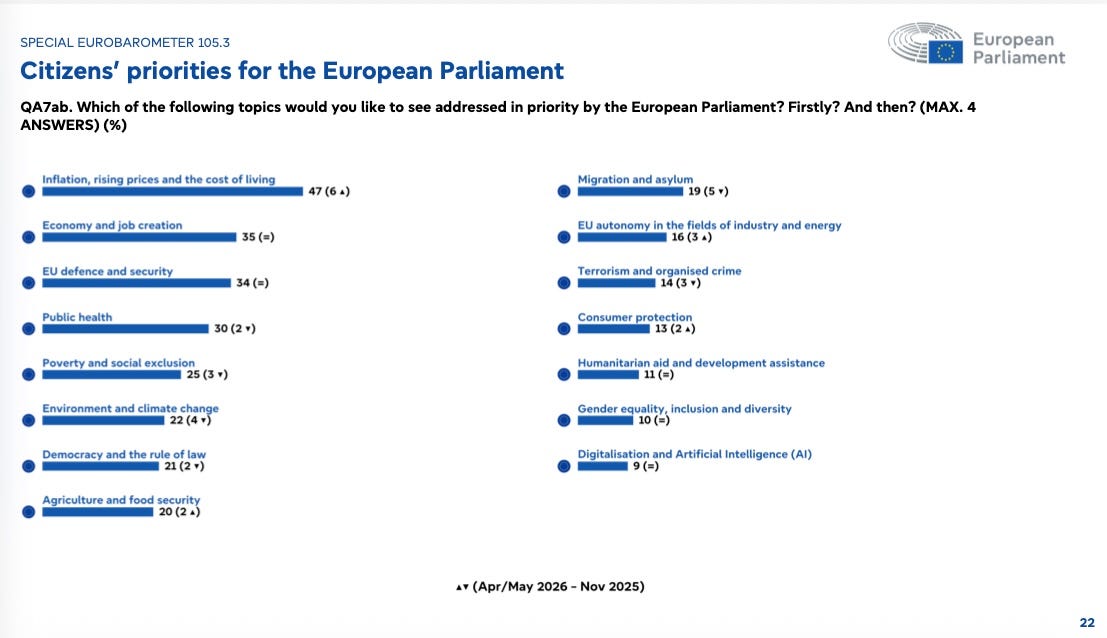
The European Parliament, however, lists these as key issues until the 2029 elections: competitive and sustainable prosperity; external affairs, trade and neighbourhood; defence, security, internal affairs and crisis management; structural and social policies; health, climate and environment; and democracy, tech sovereignty and consumer protection. While some of these match citizens’ top concerns, others appear to focus on the issues that are least relevant to europeans.
Portugal Has Banned Burqas and Niqābs in Public Spaces
On 18 August, Portuguese President António José Seguro signed a law banning face-covering garments in public places, including burqas and niqābs worn by Muslim women. The measure, proposed by the opposition party Chega, was approved by parliament in July, reports EU Perspectives.
The ban applies in public spaces such as streets, public services, businesses, sports events and demonstrations. Exceptions allow face coverings for health, professional, artistic, security or weather-related reasons, as well as in places of worship, on planes and in diplomatic settings. Under the law, fines range from 150 to 3,000 euros, depending on whether the breach was negligent or deliberate. A separate penalty applies to anyone who forces another person to cover their face through violence, threats or abuse of power.

Although the law does not mention any specific religion, it is widely understood to target the burqa and niqab primarily. It distinguishes between women forced to wear a face covering and those who choose to do so voluntarily. A woman who wears one of her own free will may be fined, while if she was forced to wear a veil, the person exerting pressure may face punishment.
France was the first European country to introduce such a measure in 2011, banning garments that cover the entire face in public. Belgium, Bulgaria, Austria and Denmark also regulate face coverings in public places in various ways.

According to Amnesty International Portugal a ban on face coverings is more likely to restrict women’s participation in society than to promote their independence. Amnesty argues that although earlier versions’ direct references to Islam have been removed, the law still violates the rights of Muslim women. But it is worth noting that the European Court of Human Rights ruled on France’s ban in 2014 (S.A.S. v. France). The Court accepted France’s argument that showing one’s face may be necessary for social coexistence, agreed the ban served the legitimate aim of protecting the rights and freedoms of others, and recognised the measure as proportionate, granting states wide discretion on the issue.
Musk’s xAI is Taking Users to Court
Elon Musk’s xAI has adopted a highly unusual and aggressive strategy by suing users of its AI Grok. The aim is to counter legal disputes in which alleged victims are suing the xAI because Grok generated child sexual abuse material, reports Politico.

For example, xAI sued two users, claiming they breached the platform’s terms of service by using Grok to generate pornographic images of children. One is Arkansas-based photographer Russell Bloodworth, who faces over 100 criminal charges for allegedly using Grok to transform his professional photographs of children into child sexual abuse material. “[Bloodworth’s] actions were a calculated scheme to weaponise the Plaintiff’s tool for criminal ends, exposing real victims to profound and lasting harm, whilst exposing the Plaintiff to significant legal risk and reputational damage,” states xAI’s complaint. Bloodworth has pleaded not guilty.
In a second lawsuit, xAI sued Terry Wayne Harwood, a South Carolina man also accused of using Grok to create child sexual abuse material. Harwood has been charged with the sexual exploitation of a minor.
Through these actions, the company seeks to hold users liable for “all reasonable costs” incurred by xAI in related legal proceedings, including damages for “reputational harm.” In other words, xAI aims to shift the costs arising from Grok-related disputes onto those who caused them.
The company must defend itself in several court cases concerning nude or explicit images generated by Grok. It faces at least two further class-action lawsuits. There are also at least four individual lawsuits linked to Bloodworth’s alleged offences, and according to the plaintiffs’ representative more are expected. In all cases, it is alleged that xAI does not employ adequate safeguards to prevent non-consensual sexual deepfakes.
According to John Coyle, a professor of law at the University of North Carolina and a specialist in commercial contracts and litigation, it is very rare for a company to enforce its terms of service through the courts. In his view, other companies tend not to act this way, primarily because it harms the brand’s reputation.
To date, xAI has generally suspended or closed accounts for breaches of its terms of service and reported abusive and sexual material to the authorities. In 2026 alone, xAI sent approximately 74,000 such reports, leading to more than 240 arrests.
xAI aka Grok suing users—resulting in arrests of child pornographers—sounds refreshing. Too many providers continue to try to hide from responsibility for the misuse of their product. Hope this sets a trend.