


Over the past week, the following topics attracted our attention:
EU Parliament Pushes Social Media Ban for Under-16s
EU Council Approves Chat Control 2.0
World’s Strongest Woman Winner Stripped of Title over Transgender Revelation
International Energy Outlook Report: Death Knell for the Climate Era
Trump Designates Muslim Brotherhood Branches as Terrorist Organizations
EU Parliament Pushes Social Media Ban for Under-16s
On Wednesday, the European Parliament adopted a non-binding report containing calls to ban social media for youngsters under 16 years of age. Lawmakers believe that social media can have a negative impact on mental health and online debate, writes Euronews.
According to the report, children and young people under the age of 16 would no longer have unrestricted access to social media, video sharing platforms, and artificial intelligence chatbots, as research shows that one in four minors uses smartphones problematically, i.e. they have a certain degree of addiction. More specifically, children under the age of 13 would be completely banned from accessing social media, and the youth in ages of 13 to 16 would need explicit parental consent.
Manipulative design solutions, such as the ability to scroll endlessly, automatic playback, and personalized recommendation algorithms, all harm children’s well-being, concentration, and sleep. The report therefore calls for a ban on such features for minors, as well as on targeted advertising, influencer marketing, addictive design, engagement-based recommendation systems for minors, and randomized gaming features (in-app currencies, fortune wheels, pay-to-progress). The report also calls for the protection of minors from commercial exploitation, including a ban on financial incentives for kidfluencing (children acting as influencers). In addition, urgent measures are needed to combat artificial intelligence, including deepfakes, companionship chatbots, AI agents, and AI-powered nudity apps (that create non-consensual manipulated images).
If a company fails to comply with these future requirements, it could be fined or banned from operating in the EU market, and company executives could be held personally liable. Members of the European Parliament believe that platforms are responsible for ensuring that their services are safe and suitable for younger users. Lawmakers also expressed their support for the age verification application being developed by the European Commission and praised the plan to introduce a European Digital Identity Wallet.
Critics, however, warn that this measure, which is being promoted for the noble purpose of protecting children, will likely lead to the need to use digital IDs, including the EU Digital Identity Wallet, in addition to the age verification application being created by the EU. According to the report’s suggestions, age verification would need to be performed regularly, using technology approved by the authorities, so as to register and authenticate the user’s presence on the web. Critics argue that mandatory identity checks and digital wallets will destroy anonymity on the internet. According to the defenders of social media as a platform for free speech, such as Tesla and X owner Elon Musk, European authorities are trying to silence alternative voices through regulation.

European Commission President Ursula von der Leyen also spoke about age verification on the internet in her September speech, emphasizing that the Commission is closely watching Australia, where age verification will come into full effect in just a few weeks. “I am watching the implementation of their policy closely to see what next steps we can take here in Europe. I will commission a panel of experts to advise me by the end of this year on the best approach for Europe,” von der Leyen said. “We will approach this carefully and listen to everyone. And in all this work we will be guided by the need to empower parents and build a safer Europe for our children,” she added.
Just a week ago, French President Emmanuel Macron sharply criticized American technology companies and Chinese algorithms, referring to TikTok, although he did not name the latter, as a place where people are harassed, bullied, and an extreme culture is created. According to the president, these platforms do not promote freedom of speech, but rather encourage a “wild west” environment with little oversight. Macron has called for more measures to “create digital sovereignty that protects children, teenagers, and democratic space.” Similar thoughts were expressed during a parliamentary debate by the Danish representative Christel Schaldemose, who described the current internet environment as an uncontrolled experiment. “We are in the middle of an experiment, an experiment where American and Chinese tech giants have unlimited access to the attention of our children and young people for hours every single day almost entirely without oversight,” Schaldemose said, naming Elon Musk, Mark Zuckerberg, and the Chinese Communist Party and their tech proxies at TikTok as participants in that experiment. According to Schaldemose, Europe is finally drawing a line with its current proposal and clearly stating that “your services are not designed for children, and the experiment ends here.”
In a non-binding vote held in Strasbourg, Parliament approved the proposal by an overwhelming majority: 483 in favor, 92 against, and only 86 abstentions. Parliament called for much stricter enforcement of current digital rules, in particular the Digital Services Act, which covers the protection of minors on the internet.
EU Council Approves Chat Control 2.0
On November 26, 2025, the Council of EU approved a draft regulation to combat child abuse on the internet by forcing platforms to remove illegal content. This is supposedly voluntary, as the obligation to scan all private messages, which was included in the earlier draft, has now been removed from the latest version. However, the draft quietly establishes what critics describe as an indirect pressure system, writes Reclaim The Net.
According to the draft, service providers must assess whether their services could potentially be used to distribute child sexual abuse material or groom children. Based on the risk assessment, companies are required to implement mitigation measures approved by the authorities. Companies must prevent the distribution of child sexual abuse material and the grooming of children. Competent national authorities will also have the right to oblige companies to remove and block content and, in the case of search engines, to remove search results. However, incentives and penalties are tied to the effectiveness of risk mitigation measures, including “voluntary” scanning.
The proposed measures would also create a new European agency, the EU Centre on Child Sexual Abuse, whose task would be to enforce the regulation and monitor compliance, including whether companies have removed content or blocked access to it. The new center will also create, manage, and operate a database that collects reports from service providers, supports national authorities, and shares information with Europol and other law enforcement agencies. The center will also create a database of indicators of child sexual abuse, which companies can use in their “voluntary” activities.
Despite the fact that the word “mandatory” has now been removed from the message monitoring option, critics believe that the structure of the new agreement is such that mass message scanning will continue in practice. Intrusive surveillance is becoming more of an expectation than a legal requirement, and there may still be pressure to install scanning tools that examine both encrypted and unencrypted communications.
Although large technology companies have reportedly welcomed the compromise, the Brussels-based lobby group CCIA Europe has expressed caution. “EU Member States have made it very clear that the CSA Regulation can only move forward if these new rules to prevent and combat child sexual abuse strike a true balance – protecting minors while maintaining the confidentiality of communications, including end-to-end encryption,” the organization said in a statement. The CCIA hopes that this principle will guide negotiations until the final version of the measure is adopted.
Privacy advocates are not reassured by the current “compromise.” For example, former European Parliament MEP Patrick Breyer believes that the system, even in its current form, paves the way for the creation of a mass surveillance infrastructure. In his view, the Council’s text replaces legal coercion with financial and regulatory incentives. These will ultimately force large American technology companies to choose indiscriminate message scanning. He wrote: “The headlines are misleading: Chat Control is not dead, it is just being privatized. What the Council endorsed today is a Trojan Horse. By cementing ‘voluntary’ mass scanning, they are legitimizing the warrantless, error-prone mass surveillance of millions of Europeans by US corporations, while simultaneously killing online anonymity through the backdoor of age verification.” Former Dutch MEP Rob Roos accused Brussels of acting “behind closed doors” and warned that “Europe risks sliding into digital authoritarianism.”
In addition, there is a risk that “voluntary” message screening will eventually be combined with the mandatory age verification described previously. The latter, in turn, threatens to eliminate all anonymity on the internet, as requiring “reliable” identification of minors means checking everyone’s identity using ID cards, face scanning, or other methods. For journalists, activists, and anyone who depends on anonymity, this system could make private communication virtually impossible.
Negotiations on the ChatControl draft have been ongoing since 2022. The Czech, Spanish, Belgian, Hungarian, and Polish presidencies failed in their attempts to develop a workable model, but the current presidency, Denmark, has managed to achieve the compromise described above, which has now been approved by the European Council despite opposition from the Czech Republic, the Netherlands, and Poland. Next year, negotiations between the European Parliament and the Commission are expected to conclude before the current e-privacy regulation, which allows companies to carry out such “voluntary” scanning, expires.
World’s Strongest Woman Winner Stripped of Title over Transgender Revelation
Jammie Booker, who won the Women’s Open category at the 2025 Official Strongman Games World Championships held in Arlington, Texas, over the last weekend, was disqualified just a few days after the competition, for the organizers discovered that the winner was born a man and had not disclosed this information to the organizers, writes The New York Post.
According to the organizers, Booker violated the competition rules, which require athletes to compete in a category that corresponds to their biological sex recorded at birth. “It appears that an athlete who is biologically male and who now identifies as female competed in the Women’s Open category,” the Official Strongman Games organizer said on social media. The organizer added that if they had known about this fact before the competition, the athlete would not have been allowed to compete in the women’s open category.

The decision to strip the athlete of her title was made after British weightlifter Andrea Thompson stormed off the podium in second place, angry at the decision to award the title to Booker. Following the latter’s disqualification, Thompson is now the winner, and the organizer emphasized that athletes can only compete in the category corresponding to their biological sex at birth. “Official Strongman is inclusive and proud to run events which do not discriminate against athletes based on personal characteristics. Any athlete is welcome. But it is our responsibility to ensure fairness and ensure athletes are assigned to men or women’s categories based on whether they are recorded as male or female at birth,” the organizer said in a statement.
According to three-time champion Rebecca Roberts, no one was aware during the competition that Booker was a man, and what happened over the weekend was not transparent. “Transgender women, people born male, should not be competing in the women’s category,” she said in a statement before Booker’s title was revoked. Roberts added that her message is simple: although transgender people also belong in sports, “women’s divisions must remain biologically born female-only.”
Booker has not yet publicly commented on her disqualification. Organizers said attempts to contact her after the competition have been unsuccessful.
International Energy Outlook Report: Death Knell for the Climate Era
The International Energy Agency (IEA) has published World Energy Outlook 2025 – a report that reads like an obituary for the climate era’s fantasies about rapidly reducing global CO₂ emissions, as it acknowledges the undeniable truth that countries prioritizing prosperity must continue to rely on coal, oil, and natural gas, writes Watts Up With That.
For years, the IEA and Western think tanks have consistently claimed that hydrocarbons are being used less and less and have predicted a sharp decline in demand after 2030. However, in its latest report, the IEA acknowledges that demand for oil and natural gas will continue to grow also after 2035 and may not peak until 2050.
The main conclusion of the IEA report is that developing markets, and those outside China in particular, are the main drivers of global energy consumption growth. Among all emerging market and developing economies, India is projected to have the fastest average primary energy growth, averaging ~3% per year until at least mid-century. Oil and natural gas will account for a large part of this. India’s oil consumption is projected to grow from 5.5 million barrels per day in 2024 to ~8 million barrels per day in 2035. The increase in demand will be driven by aviation and transport, as well as growing production of plastics and chemicals.
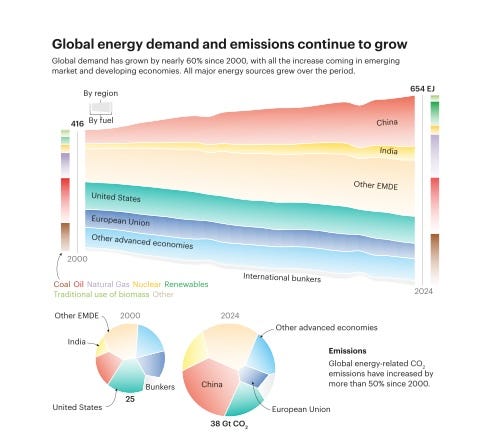
Especially striking is the continued strong growth in coal use in India and Indonesia. Until recently, coal was considered a relic of the past, but New Delhi and Jakarta will shape the dynamics of this fossil fuel for the next coming 40 years. According to the forecasts, India’s total coal demand is set to grow substantially, with industrial demand rising strongly. Nearly a quarter of new steel production worldwide is planned for India and Southeast Asia, driving major increases in coal use. At the same time, Indonesia’s coal demand is expected to increase sharply, as factories, nickel smelters, and chemical plants consume more and more energy.
The most notable conclusion of the IEA report may be the figures on the growth of electricity demand per capita. By 2035, per-capita electricity demand in India is projected to grow by ~80% and in Indonesia by ~70%. This huge growth is driven by air conditioning, household appliances, urbanization, and continuous population growth. Indonesia has almost doubled the reach of its electricity grid in the past decade, adding approximately one million kilometres of new lines.
The IEA report also notes that India has already installed its 2030 non-fossil capacity target ahead of schedule. Nevertheless, fossil fuels still account for the majority of actual electricity generation, because variable renewable sources are unstable and intermittent. Only fossil fuels, together with nuclear and hydro, can currently provide the dispatchable reliability that industry needs and that modern societies expect.
Trump Designates Muslim Brotherhood Branches as Terrorist Organizations
US President Donald Trump signed an order on November 24 initiating proceedings to designate certain branches of the Muslim Brotherhood as terrorist organizations. The US President specifically mentions branches of the Muslim Brotherhood in Lebanon, Egypt, and Jordan that “participate in or promote and support violence and destabilization campaigns that harm their own regions, US citizens and US interests,” writes France24.
It is now up to Secretary of State Marco Rubio and Secretary of the Treasury Scott Bessent to complete the banning of the branches named in the presidential order. If the branches of the organization are designated as a foreign terrorist group, Washington can impose sanctions, such as freezing the group’s assets in the United States or imposing entry bans on its members.
The Muslim Brotherhood is an Islamist organization founded in Egypt in 1928, which later spread throughout the Arab world and elsewhere. Its founder, Egyptian teacher Hassan al-Banna, claimed that reviving Islamic principles in society would enable the Muslim world to resist Western colonialism. This spring, the French government published a report stating that the Brotherhood’s goal is to spread Islam and reshape parts of French society from the bottom up. They start with local politics, for example mosques, schools, associations, and local governments. In public, they present a moderate image, but behind the scenes they promote anti-Semitism, gender segregation, and ideological separatism.
Some countries have already declared the Muslim Brotherhood a terrorist organization, including Egypt, Saudi Arabia, the UAE, Bahrain, and most recently Jordan. In Egypt, the Muslim Brotherhood has been banned since 2013, following the overthrow of its leader and then-president Mohamed Morsi, who was removed from power in a military coup led by then-army chief Abdel Fattah al-Sisi. Sisi has ruled Egypt ever since.
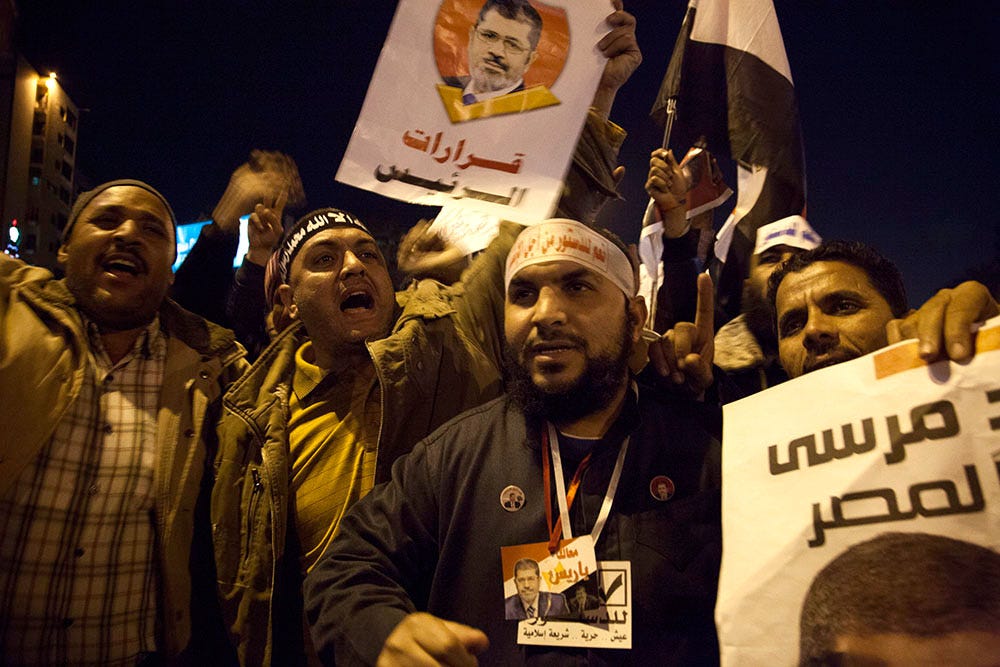
Jordan banned the movement in April this year, accusing it of manufacturing and stockpiling weapons and plotting to destabilize the kingdom. Despite this, the Brotherhood remains very popular in Jordan and has continued its activities even after the country’s highest court ruled to dissolve the group in 2020. The authorities have often turned a blind eye to the Brotherhood’s activities.
Despite the fact that the Muslim Brotherhood has managed to gain a foothold in Europe in recent years, European countries are still reluctant to designate the Muslim Brotherhood as a terrorist organization. In June 2021, Austria became the only country to ban the Muslim Brotherhood under its anti-terrorism law. However, following the publication of the report, French President Macron also announced that he would introduce measures to combat Islamism by imposing sanctions and increasing surveillance of organizations. The measures include plans to freeze financial support for certain organizations and ban activities, as well as plans to improve the training of imams, to reduce their dependence on their countries of origin.
In Germany, the right-wing Alternative for Germany (AfD) party has sought to follow Austria’s example and in January this year submitted a bill to ban Islamist organizations, targeting the Brotherhood in particular. Although neither the Brotherhood nor its branches have been banned in Germany at present, the country has taken some steps. In November, the influence group Muslim Interaktiv was banned on charges of unconstitutional activity, namely seeking to establish a caliphate and promoting anti-Semitism and discrimination against women.