


Over the past few days, the following topics attracted our attention:
Fauci’s Ex-Adviser Pleads Guilty in COVID Records Conspiracy
The BMJ Retracted a Scientifically Sound Vaccine Study
UK Taxpayers Have Paid £1 Billion to Switch Off Wind Farms This Year
Fauci’s Ex-Adviser Pleads Guilty in COVID Records Conspiracy
The US Department of Justice’s Maryland office announced on 18 August that David M. Morens, a former employee of the National Institute of Allergy and Infectious Diseases (NIAID), had pleaded guilty in federal court to a conspiracy charge involving concealing documents during the coronavirus pandemic. More specifically, the charge covered conspiracy aimed at obstructing compliance with the Federal Records Act and requests relating to coronavirus research grants made under the Freedom of Information Act (FOIA).


From 2006 to 2022, David M. Morens, 78, served as a senior scientific adviser to the director of NIAID – who at the time was Anthony Fauci – and advised senior staff on policy matters. He drafted recommendations and solutions that influenced the National Institutes of Health (NIH) and guided staff on epidemiological studies and infectious disease issues. Morens also gathered information from grant recipients and researchers to verify facts about the coronavirus. By virtue of his position he was aware of prior NIH and NIAID coronavirus research and relayed information to NIAID leadership.
According to court documents, Morens conspired with at least two accomplices to commit multiple acts of fraud during the coronavirus pandemic and has now pleaded guilty to one count of conspiracy covering these charges. He admitted that during the coronavirus pandemic he had agreed with two accomplices to defraud the United States after the NIH terminated funding for the project ‘Understanding the Risk of Bat Coronavirus Emergence’ (see also here). The grant was terminated based on claims that COVID-19 originated at the Wuhan Institute of Virology (WIV) in China (see also here, here, here, here, here). NIAID awarded the grant to a company and the first accomplice, who had passed sub-award funds on to the Wuhan Institute of Virology.
Morens, however, together with a second accomplice, promised to help the first accomplice secure renewed funding for the bat coronavirus project and to do everything possible to refute claims of a laboratory leak of the coronavirus. Anticipating that such correspondence might be made public under the Freedom of Information Act (FOIA), Morens agreed in writing with his accomplices to conceal their communications. To do so, they used Morens’s personal Gmail account instead of his official NIH email (see also here). In private emails, the parties exchanged NIH information and discussed how to influence the NIH to fund a certain company. They sent each other drafts of letters intended for NIH leadership and relayed information to a high-ranking NIAID official through covert channels. All of these were government documents that should have been created, stored and exchanged via the government’s official systems.


Furthermore, Morens admitted that he and his first accomplice had also discussed the payment of illegal gratuities, and that the accomplice had given Morens wine as a gift for his ‘behind-the-scenes shenanigans’. In return for the gift, Morens rendered a ‘worthy’ favour by writing a scientific commentary for a medical journal which claimed that COVID-19 was of natural origin. The same accomplice offered Morens other valuable benefits, such as dinners at Michelin-starred restaurants in Paris, New York and Washington.
Morens’s attorney, Tim Belevetz, stated that by pleading guilty, Morens has taken responsibility for his actions and intends to continue to do so.
The US Attorney’s Office for the District of Maryland estimates that Morens could face up to five years’ imprisonment for conspiracy to defraud the United States. However, actual sentences for breaches of federal law are usually lighter than the maximum penalties.
The BMJ Retracted a Scientifically Sound Vaccine Study
The British Medical Journal (BMJ) is accused of undermining scientific integrity after retracting a 2024 article by Dutch researchers that suggested Covid-19 vaccines might contribute to excess mortality. No errors, malice or falsified data were found, but the work allegedly did not “reflect the scientific consensus” and focused too heavily on vaccination’s negative effects. The study’s authors believe the reason is political, reports The Telegraph.
Dutch researchers published the study in 2024, finding that excess mortality in 47 Western countries totalled 3,098,456 people between 2020 and 2022. Excess deaths were recorded in 41 countries (87%) in 2020, 42 (89%) in 2021 and 43 (91%) in 2022. The peer-reviewed paper concluded that excess mortality remained consistently high across all three years and appeared independent of COVID-19 containment measures and vaccines. Researchers called this unprecedented and urged further investigation. After a nine-month review, BMJ Public Health initially accepted the study as accurate and fit for publication.
Shortly after publication, the BMJ issued a clarification noting concerns about the article’s quality, originality and messaging. It stressed that the paper neither investigated nor proved any causal link between COVID-19 vaccines and mortality. The Princess Máxima Centre in Utrecht, where three of the authors worked, agreed to investigate. The centre found no evidence of malice, fabrication or falsification, yet judged the work misleading and selective. It said the article had a “negative effect on confidence in science” and a “negative impact on society” as it paid disproportionate attention to vaccination’s possible negative effects, citing supportive literature while under-citing alternative interpretations.
The BMJ has now retracted the study, citing “misinformation in the discussion regarding the possible causes of excess mortality” and the fact that “the limited nature of the original work by the authors was not sufficiently described.” Two authors, Professor Gertjan Kaspers and Dr Minke Huibers, also requested the retraction because they feared misinterpretation could harm public health. They did not, however, accept that the paper contained false data.
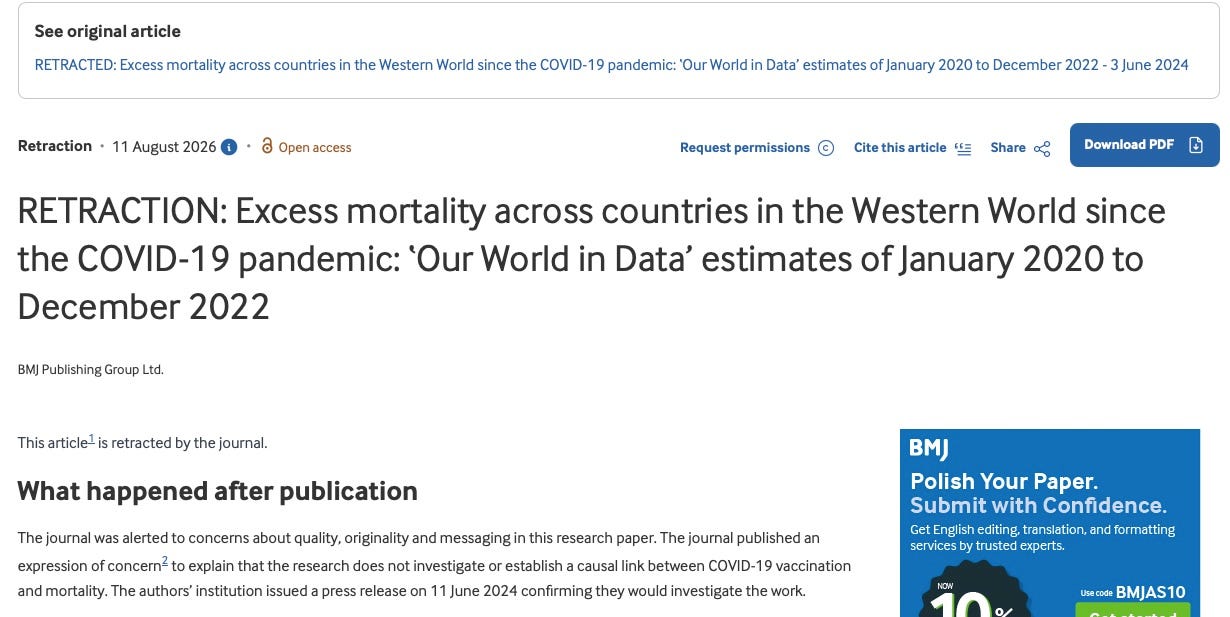
A BMJ spokesperson stated that peer review is imperfect and that the journal values post-publication scrutiny. “Overall, the journal concludes that the discussion of causes of mortality is imbalanced, lacks rigour, and includes misinformation. We gave the lead author an opportunity to correct the conclusion but her proposed correction did not go far enough, and the problems with the work’s originality could not be fixed. We did not retract the paper because of the wider reporting of the work. This is not a criterion for retraction,” explained the spokesperson.
Dr Saskia Mostert (who has left the Princess Máxima Centre) and independent critics, including Professor Ronald Meester of probability theory at Vrije Universiteit Amsterdam, have written to the BMJ asking for the decision to be reviewed. Mostert said the publication was met with “irrational and blind fury” she could not have anticipated. Meester stated there were no scientific grounds for retraction and suggested external pressure may have played a role, though the source remains unclear. “Hence the real reason must be political. Very sad, really, for science. I do not see how we can take science seriously anymore when editors are willing to make decisions for these kinds of reasons,” he remarked. The letter to the BMJ argued: “Retraction is disproportional and raises serious questions about the extent to which political considerations played a part in your decision. Critics say the move undermines the credibility of published research and “sets a terrible precedent in these times of increasing political pressure on scientists.”
Dr Jona Walk, a Dutch researcher in immunology and infectious diseases, supports this view. She believes the BMJ withdrew the article mainly because of how it was covered in the media. “There were no methodological, data or analysis flaws in the paper,” she confirmed. “The real reason for retraction can be found in their earlier ‘expression of concern’: the editors disagreed with how the paper was presented in the media - not by the authors themselves, but by journalists. That is a political and not a scientific reason,” Walk wrote on X.


UK Taxpayers Have Paid £1 Billion to Switch Off Wind Farms This Year
This year’s figures from the UK show that taxpayers have already paid £1 billion (€1.17 billion) for the wind energy surplus. The country reached this figure two months earlier than last year, according to GBN.
According to Wasted Wind, a subsidiary of Octopus Energy, £21 million (€24.6 million) in wind energy compensation was paid on 2 July alone. In total, the UK has already spent £1.02 billion (€1.19 billion) on such compensation this year - £300 million (€351 million) more than during the same period last year.
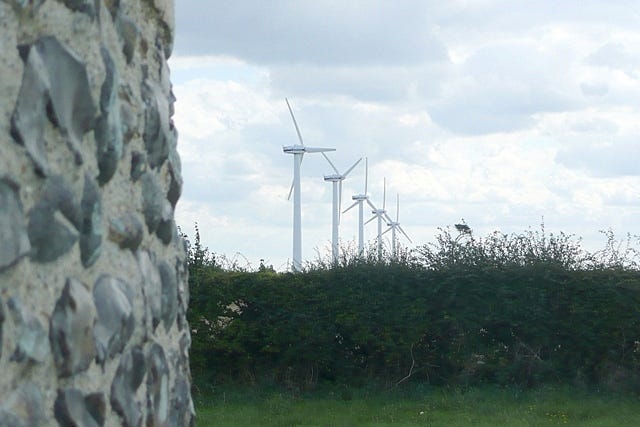
This is compensation paid by the state when remotely located wind farms generate more energy than the grid can handle. The state pays wind farms to reduce output. At the same time, other parts of the country may face shortages that must be met with gas-fired electricity, raising costs further.
Last year, the total compensation paid by taxpayers was £1.45 billion (€1.70 billion). Network operator Neso forecasts that next year’s figure could reach £3.2 billion (€3.74 billion), while Octopus warns that by the end of the decade it could hit £10 billion (€11.7 billion) a year.
Uk regulating officials can't seem to do math. X number of windmills can generate X number watts of power in an X radius added to the power grid predetermined by past average usage. Either that or just another government program to cipher off taxpayer dollars to contractors pocket.