


Over the past few days, the following topics attracted our attention:
Fauci’s NIAID Funded Dangerous Ebola Studies
Australia to Deploy AI to Shape Public Opinion
UK Cuts Empty-Home Takeover Time to Six Months
Fauci’s NIAID Funded Dangerous Ebola Studies
Senator Rand Paul has released further documents from Anthony Fauci’s diary and emails. In these, Fauci describes dangerous studies funded by NIAID, including a 2015 experiment in which vaccinated monkeys were exposed to aerosolised Ebola, according to Senator Rand Paul.
The study was organised by the US Army Medical Research Institute of Infectious Diseases (USAMRIID) under a NIAID task order. It compared the efficacy of four Ebola vaccines in four groups of monkeys that were exposed to the Ebola virus via an aerosol. The method drove the virus deep into the lungs in a way that would not occur in natural infection. According to Fauci’s notes, the vaccinated monkeys developed pulmonary necrosis, inflammation and fibrin, conditions not seen in the unvaccinated controls. Almost all the monkeys died, both vaccinated and unvaccinated, though the vaccinated animals showed more severe lung pathology.


In a diary entry dated 7 March 2016, Fauci wrote: “What idiots those guys at USAMRIID are. The work should have been a classified experiment that never should have been done in the first place.” Two days later, however, he noted that the trials were “important for bio-defence”.
But Fauci was furious when the failed vaccine trial data was shared with US embassy officials in Guinea, Liberia and Sierra Leone. In his view the trial should have been classified. He wrote that “the foolish DOD people sent the data to the FDA and then circulated it as FYI to various embassies, including those in West Africa, where we are about to embark on a much larger DSD vaccine trial for Ebola.” Embassy officials “went bonkers since it looks like we’re going to vaccinated people with the dangers vaccine”.
Whilst Fauci’s documents repeatedly claim the study should have been classified, the NIAID report states that no such authorisation had been sought and that classification was not mentioned. Moreover, the data had already been passed to vaccine manufacturers, some of whom had published the information. Fauci, however, expressed alarm when the Department of Defense clarified that the study had been funded by NIAID. He raised the same concern with other NIAID staff and discussed ways to “limit” the damage. For Fauci the problem was not the experiments themselves, but the risk that the public might learn of them. He therefore sought to classify the study urgently, even though the Department of Defense wished to publish it. “I said that I thought it should be classified, and the NSC people blew them out of the water and said they agreed with me,” Fauci wrote.
Subsequently, NIAID Deputy Director H. Clifford Lane forbade researchers from continuing the Ebola experiments until the situation had calmed. He warned that “one might consider this dual-use research” and ordered colleagues to keep quiet. NIAID researcher Peter Jahrling replied that if aerosol challenge studies were treated as dual-use research of concern, “the entire MCM [Medical Countermeasures] development paradigm is gutted.” He added that, while Ebola vaccine research had been suspended, plans to begin coronavirus-related research were still proceeding as soon as possible.
Australia to Deploy AI to Shape Public Opinion
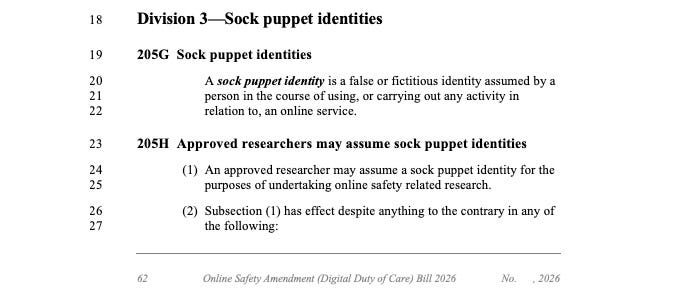
The Australian government is proposing extensive new powers for eSafety, the online safety regulator, through the draft Online Safety Amendment (Digital Duty of Care) Bill 2026. These new provisions would allow the eSafety Commissioner to create ‘sock-puppet’ identities - that is, fake or fictitious identities - to be used anonymously under the pretext of online safety. The eSafety Commissioner would also be granted the right to manage these fake accounts and generate content using artificial intelligence. According to the government, the broader Digital Duty of Care framework is intended to establish safety requirements for digital platforms and give Australians greater control over certain algorithmic features, including news feeds. Critics, however, argue that the new provisions will allow the authorities to monitor citizens via fake accounts and, in principle, to create content that could be used to influence public opinion, reports News24.
The e-Safety Commissioner may create and use such fake accounts on online services. These accounts may be used to upload and download material, interact with platforms and test their functions. In certain circumstances, they may also be used to interact with other users, although, according to the draft bill, this is permitted only where necessary to prevent the account from being suspended. According to a spokesperson for the Department of Communications, this is an opportunity to test the systems that platforms have in place: “Sock puppet accounts will allow the eSafety Commissioner and accredited academics to test the systems platforms have in place to protect Australians from harms such as child sexual abuse, extreme violence and terrorism.” The Department states that such accounts will not be used to target individual accounts. Online safety researchers may also adopt sock-puppet identities themselves, but while the eSafety Commissioner may create content using online services, including through artificial intelligence, researchers do not have such authorisation.
A heated political debate has now flared up in Australia over whether such internet laws might ultimately be extended to cover false information, disinformation and political speech. In his remarks in New York at the UN General Assembly, Prime Minister Anthony Albanese initially connected the Digital Duty of Care discussion with misinformation, disinformation and political polarisation. Following his speech he explicitly denied that he was linking those issues to the legislation and said the proposal was about giving users control over algorithms. He explained: “This isn’t about government control at all. It’s not about misinformation or disinformation. What this is about is giving people control – giving you, when you’ve got that device in your hand, control over which algorithms you want to receive.” He said that social media’s role in increasing polarisation was a different issue from government taking action to control what people receive online.
Margaret Chambers, a researcher at the free-market think tank Institute of Public Affairs, expressed concern about the information warfare that the ‘sock puppet’ provisions could provoke. “The sock puppet identity provision, particularly the unlimited authorisation for the Commissioner to generate material using AI, should be understood as an effort by the government and the eSafety Commissioner to engage in information warfare,” said Chambers. She argues that the Commissioner’s approach to online safety is ideological and extends to the censorship of political debate, and that the agency is seeking to use artificial intelligence to promote what she describes as an ideologically sanitised view of the internet.
According to other critics, the aim of the draft Digital Duty of Care Bill is ostensibly noble – to protect children from harmful content and give adults greater control over their news feeds. At the same time, however, they argue that hidden within the maze of provisions is a significant expansion of regulatory power, with the eSafety Commissioner’s powers continuing to grow. Critics describe these measures as a case in which protection could become a pretext for surveillance and control. With regard to sock-puppet accounts, critics point out that such accounts allow online activity to be monitored and material to be stored, while the authorities may also create material for these accounts, including through artificial intelligence. They therefore argue that the provision goes beyond passive monitoring and could extend to active influence. At the same time, critics argue that the authorities have not sufficiently specified how these new powers will be used or set clear limits on their exercise.


Furthermore, the draft bill broadens the regulations on lawful speech by classifying lawful content – albeit often unpleasant – as ‘harmful’. Platforms are, however, required to take preventative measures to create a safe online environment in relation to these ‘harmful’ categories. Critics argue that the result is a new set of restrictions on freedom of expression, in which content may remain lawful while nevertheless being subject to regulatory pressure on platforms. For example, one category deemed harmful to children covers material or behaviour that “incites or promotes hostile attitudes towards women or gender equality”. At the same time, critics question how clearly the draft defines when a particular attitude might be considered hostile or contrary to gender equality. For example, might a statement criticising gender ideology, a feminist discussion of pornography, a religious sermon, a discussion by men’s rights advocates on family law, a historical perspective on gender roles, or even a comedian’s performance be considered ‘harmful’ in the future? These are hypothetical examples rather than categories specifically identified by the draft. In any case, critics argue that it is legitimate to ask who decides where dissent ends and harm begins.
UK Cuts Empty-Home Takeover Time to Six Months
The UK government has announced amendments to the Empty Dwelling Management Order (EDMO). The changes expand the circumstances under which local authorities can take over the management of vacant dwellings and return them to use for up to seven years. Ownership will remain with the original owner, reports The Telegraph.
The EDMO regime has existed for around 20 years but has rarely been used because the rules were seen as too restrictive. A property currently has to have stood vacant for two years without a valid reason and caused a negative impact on the neighbourhood - for example if it has been taken over by criminals or anti-social behaviour. Well-maintained properties that are simply empty have generally fallen outside the rules. The government now plans to simplify these requirements.
Under the new plan the vacancy period will be cut from two years to six months. Officials say this will let councils act more quickly and prevent serious deterioration. Ministers also intend to speed up the process by which councils apply through the Residential Property Tribunal. Certain proof requirements - such as evidence of anti-social behaviour or community support - will be removed. Local authorities will in future be able to apply for residential property for their own use through an arbitration tribunal.
Housing Minister Matthew Pennycook said the aim is to strengthen councils’ powers so they can take control of long-term empty homes and make them available to families in need. He wrote: “It’s not a silver bullet but bringing more empty homes back into use can help solve the housing crisis.”

The government is also looking at further ways to improve the system and support local authorities. Every long-term vacant property is presented as a missed opportunity to provide permanent housing, revitalise communities and make better use of existing stock. Official figures showed 303,185 homes in England had been empty for long time and their number is expected to continue to rise.
Critics argue that recent changes under the Renters’ Rights Act have made it harder to evict problematic tenants while raising costs for landlords. They say the government has made private letting more difficult, which can leave properties empty for longer while owners search for reliable tenants. Now, however, the government is adding fuel to the fire and dealing property owners yet another blow by allowing local authorities, in principle, to confiscate private property if it has stood empty for just six months. The local authority may then let out this property as it sees fit, including as social housing at a reduced rent. In any case, should such a decision be taken, management of the property would be taken out of the owner’s control, whilst all the property owner’s obligations would still remain with them.
Critics also warn that the shorter threshold could catch properties that are empty for legitimate reasons - slow sales, inheritance and probate delays, legal disputes, or major renovation work - all of which routinely take longer than six months.