


Over the past few days, the following topics attracted our attention:
Frontex: Illegal Immigration into the EU Has Decreased
Guterres Says El Niño Is Worse Because of Man-Made Climate Change
UN Warns Age Verification Threatens Privacy of Children and Adults
Frontex: Illegal Immigration into the EU Has Decreased
According to the European Border and Coast Guard Agency (Frontex), 28,500 illegal border crossings into the European Union were recorded in the first four months of 2026. Thus, the number of illegal border crossings has decreased by 40% compared to the same period last year.
The most active migration routes were the Central Mediterranean and Eastern Mediterranean routes, each accounting for about one-third of all illegal entries. In the Central Mediterranean, 46% fewer cases were recorded than last year - approximately 8,500 arrivals - mainly from Bangladesh, Somalia, and Sudan. In the Eastern Mediterranean, approximately 8,400 crossings were recorded, a 32% decrease, with the Libya-Crete corridor being the most active. Libya was the most frequently used departure point, though authorities there implemented preventive measures.
The largest decline was on the Western African route, where detected cases fell by 78%. According to Frontex, this resulted from preventive measures implemented by Mauritania in cooperation with Spain and the EU since spring 2025, and more recently by Senegal and Gambia. The only increase in entries was recorded on the Western Mediterranean migration route, where the number of detected cases rose by half. The main country of departure was Algeria, which, according to Frontex, indicates a shift in smuggling routes as stricter controls in Morocco and on neighboring West African and Central Mediterranean routes have redirected more departures to the Algerian coast.
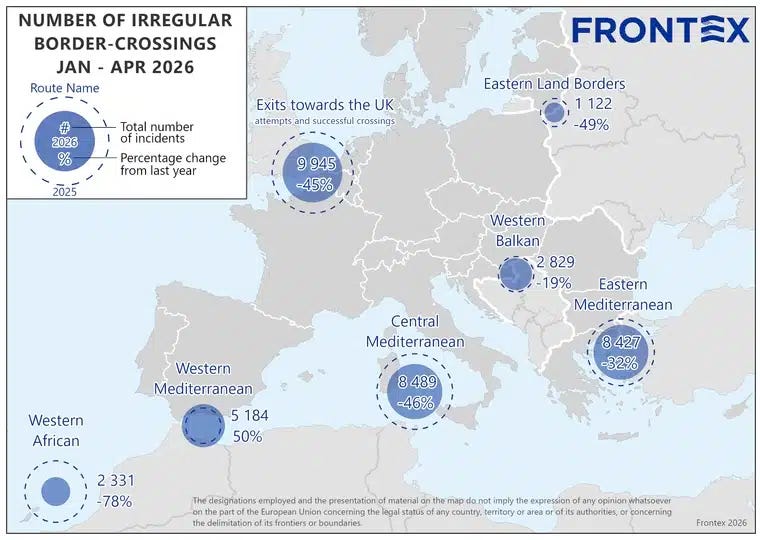
On the Western Balkans route, where the main point of departure was the border between Croatia and Bosnia and Herzegovina, approximately 2,800 cases were recorded, representing a 19% decrease. On the eastern land border, approximately 1,100 cases were recorded, representing a 49% decrease. At the same time, despite a calmer start to the year, migratory pressure from Belarus increased in March. Frontex believes this may have been due to better weather and recent legislative changes that have made it easier to access the border area. At the EU-Ukraine border, however, those crossing were mainly Ukrainian men seeking to avoid military service. Frontex also noted that detected attempts to leave via the English Channel decreased by nearly half, reaching approximately 9,900.
According to Eurostat data, 132,600 third-country citizens were denied entry to the EU in 2025, which is 7.1% more than in 2024 (123,835). The number of persons staying illegally in the EU decreased by 21.7%, from 918,525 in 2024 to 719,395 in 2025. Last year, 491,950 departure orders were issued to third-country nationals, an increase of 5.8% compared to 2024 (464,985). Of the removal orders, 135,460 were enforced, which is 20.9% more than in 2024, when 112,040 were enforced. Germany reported the highest number of returns to third countries (29,295), followed by France (14,940) and Sweden (11,250). Most of those returned came from Turkey (13,405), Georgia (10,475), Syria (8,370), and Albania (8,020).
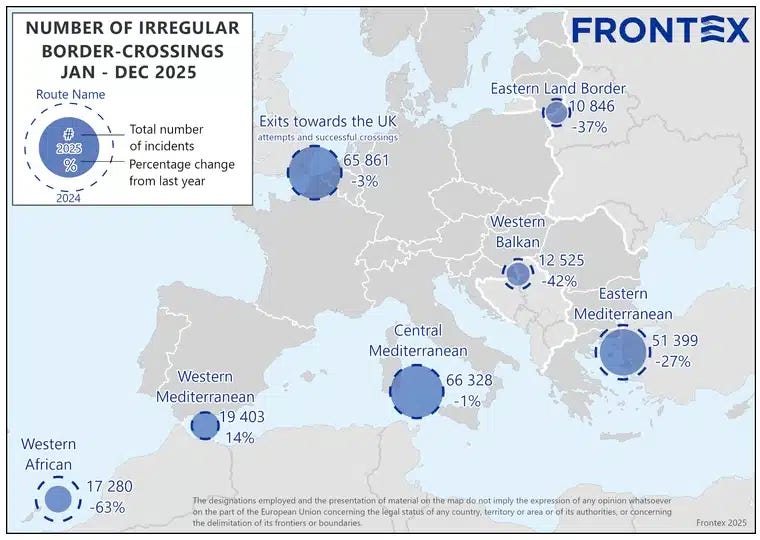
Frontex’s preliminary aggregate data for 2025 also show a decline in irregular border crossings. There were 26% fewer such crossings last year compared to the year before, or approximately 178,000. This is the lowest level since 2021. Although irregular migration has decreased recently, it remains high, and human trafficking networks continue to send people on dangerous journeys. Therefore, Frontex warns that the situation at Europe’s borders remains uncertain. Migration pressure can quickly shift from one route to another, depending on conflicts, instability, and smuggling networks. Immigration into the European Union may also be affected by the unstable security situation in the Middle East, particularly in Lebanon, from where people may attempt to reach Cyprus and other Mediterranean countries by sea.
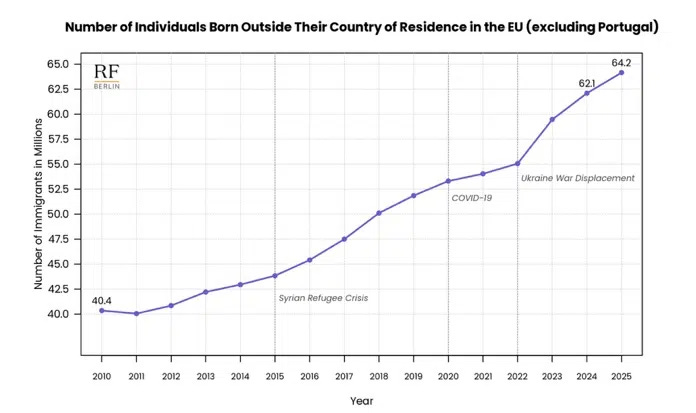
According to the Rockwool Foundation, the number of foreign-born residents across Europe increased by approximately 2.1 million in 2025, reaching a total of about 64 million in EU member states. In 2010, there were approximately 40 million foreign-born residents in the EU. The largest increase was recorded in Spain, which received about 1.22 million immigrants, accounting for approximately one-third of the total EU increase. However, the main destination remains Germany, where, according to the Federal Statistical Office, approximately 1.48 million (1.03 million according to Rockwool) foreign-born people arrived last year - a 13% decrease compared to 2024. According to German officials, the decline is due to a lower number of arrivals from the main countries of origin. For example, the net migration of Syrians decreased by 67%, that of Afghans by 41%, and that of Ukrainians by 21%.
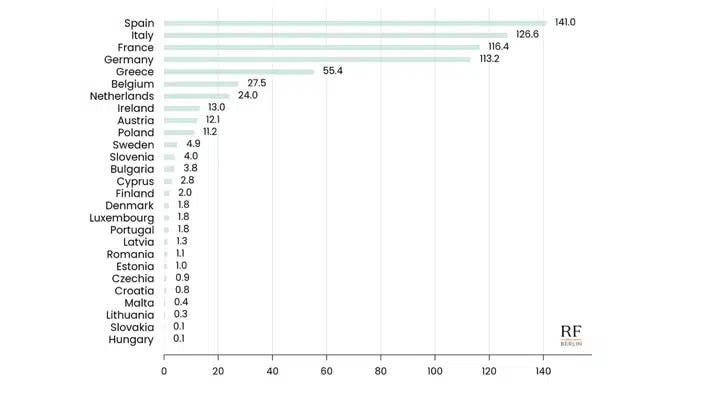
In 2025, 669,365 asylum applications were filed in the EU, a decrease of 26.6% compared to 2024. The same countries lead in asylum applications: Spain with approximately 141,000 applications, Italy with approximately 127,000, France with approximately 116,000, and Germany with 113,000. Together, these four countries account for approximately 74% of all asylum applications submitted in the EU. The largest number of applications came from people of Afghan and Syrian origin, accounting for about 42%, followed by Turkey at 11%. Other nationalities, including Somalia, Iraq, Russia, and Eritrea, each account for a relatively small share - around 4% or less. In Spain, however, 60% of applications come from Venezuelan citizens and 11% from Malian citizens. Italy receives the most people from Bangladesh, accounting for about 22% of asylum applications.
Germany leads in terms of the number of people granted refugee status, with approximately 2.7 million refugees. It is followed by Poland with about 1 million refugees and France with approximately 751,000 refugees. Spain has 471,000 refugees and the Czech Republic has 381,000.
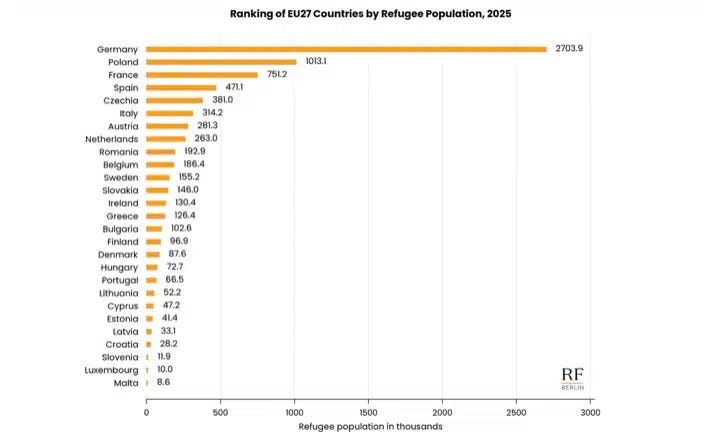
At the same time, as of the end of February 2026, 1.20 million asylum applications were pending a decision across the EU. In February last year, 1.25 million applicants were awaiting a decision, which was 4% more than this year. The highest number of pending applications are in Germany (291,245), Spain (251,140), and Italy (approx. 237,485).
UN Guterres Warns: The World Must View The Coming El Niño Phenomenon as a Climate Warning
The UN has joined scientists in warning that an extremely strong El Niño will hit the world this year, causing high temperatures and extreme weather. A new phase of El Niño could begin in just a few weeks, raising temperatures across the globe, with its peak predicted for the end of the year. In this context, the UN noted that this natural phenomenon is being amplified by human-induced climate change and that the only effective response is to implement climate action, reports the BBC.
According to the World Meteorological Organization, El Niño will develop in the middle of the year and is likely to intensify further over the course of the year, affecting temperatures and precipitation patterns and causing much of the extreme weather. National weather services are forecasting one of the strongest on record - a “super El Niño” - and and it is believed that we may see weather conditions unprecedented in recent history.


El Niño occurs when changes in wind patterns allow warmer water to spread across the tropical Pacific Ocean. Sea surface temperatures in the Pacific monitoring region naturally fluctuate above and below average. However, if they warm or cool by more than half a degree from the reference value over a longer period, conditions are favorable for the development of El Niño or its cooler counterpart, La Niña. A warming of more than two degrees indicates a very strong event. There have been only a handful of such events since 1950.
An El Niño event was expected this year in any case, but scientists have now concluded that it could be unusually powerful. Professor Adam Scaife, head of monthly to decadal prediction at the UK Met Office, said: “We’re very confident that there’s a big event coming. It may even be a record event.” In any case, a strong El Niño typically brings hot and dry weather to parts of South America, Southeast Asia, and Australia, increasing the likelihood of droughts and wildfires. At the same time, it may weaken the Indian monsoon and bring drier conditions to the Horn of Africa, but heavier rainfall to the southern United States. There may even be an increased likelihood that the UK will start the winter warmly and end it coldly.
El Niño events typically peak around Christmas. Even if this year’s El Niño does not reach “super” levels, the consequences could still be extreme. In addition to extreme weather and its associated consequences, a strong El Niño has previously caused food price increases and loss of income, as crop failures and trade disruptions ripple through supply chains and economies.
UN Secretary-General António Guterres confirmed the World Meteorological Organization’s forecast in a video message and noted that there is a 90% probability of a strong El Niño. He added that the world must treat this natural phenomenon as a climate warning. Guterres stated: “El Niño conditions will pour fuel on the fire of a warming world. Impacts will hit even harder, travel even farther, and cross borders with devastating speed. The only effective response is climate action equal to the crisis – ending the addiction to fossil fuels, accelerating the shift to renewables, protecting the most vulnerable, and delivering early warning systems for all.”
UN Warns Age Verification Threatens Privacy of Children and Adults
The UN Human Rights Office has published measures that would help make the internet safer for children. According to UN High Commissioner for Human Rights Volker Türk, both governments and tech companies should implement stronger measures to make platforms safer for children, including better regulation, oversight, and accountability. However, age verification may not be the best solution; on the contrary, it poses a risk to privacy and may push children into the darker corners of the internet.
“The digital world that connects children to learning, community, and creativity also exposes them to real risks to their safety, privacy, and wellbeing,” said Türk, but such harm is neither natural nor inevitable. “They result from design choices and business practices that undermine safety, including addictive design features, such as infinite scroll, autoplay, and persistent notifications from apps,” Türk explained.


In the Commissioner’s view, child protection online is indeed a priority, but a blanket ban on social media is not the solution. “Simply limiting access to platforms that remain unsafe cannot stand as the endpoint in effectively protecting children. We need much wider action – by Governments and companies – to ensure that the platforms themselves are made safer by design, that data is protected, that those responsible for harm can held to account, and that children’s rights and needs are fully respected throughout,” Türk stated. However, age verification leaves the design and algorithms of platforms unchanged, and it is precisely these that make the platforms dangerous. Therefore, countries should require technology companies to integrate safety into platform design, rather than shifting the burden onto parents and children.
If age restrictions are to be imposed on certain services or content, they should be targeted at clearly defined harms. The UN also recommends other measures that protect children while respecting human rights. For example, age verification must be secure; solutions must be continuously assessed for their impact on children’s rights; and, above all, it is long overdue to involve children and listen to their opinions when drafting rules that affect them. These steps must be supported by transparency, proper oversight, and corporate accountability, and children whose rights have been violated must have access to legal remedies.
In any case, no new rule should cause additional harm, such as that which age verification can entail, thereby jeopardizing the privacy of both children and adults. In conclusion, the UN High Commissioner for Human Rights emphasized that while age restrictions are easy for children to circumvent, they may still force children to use riskier and even less monitored platforms.
Yet again we see that corrupt organisation the UN staffed by people of indeterminate origin generally with brown or black skins completely ignoring the proven scientific facts about severe weather events: the facts incontrovertibly prove that these events are on the decline. Just another scam in an attempt to divert money from the civilised developed Western nations to the corrupt lazy badly governed third world nations. Thankfully people are waking up to the fact that the UN should be kicked out of their cosseted existences in NY and banished to somewhere like South Africa or better still the Congo where they belong. Time for President Trump to take action.