


Over the past few days, the following topics attracted our attention:
Macron Wants an EU-Wide Ban on Social Media
Iran War Puts Climate Crisis on Hold and Drives Global Coal Demand to Record High
Antarctic Ice Sheet Has Been Gaining Ice Since 2020
Macron Wants an EU-Wide Ban on Social Media
France’s failed attempt to ban social media for under-15s has not deterred President Emmanuel Macron. He now wants to take the fight to Brussels and push for an EU-wide ban. “I believe it has now become essential to go further and, through a new European legislative text, harmonise a ban on access to social media platforms for children under the age of 15,” Macron wrote. According to him, the measure is needed to protect all children in the Union, writes EU Perspectives.
France had advanced a bill that would have stopped under-15s from opening social media accounts and required platforms to close existing ones. In August, however, the French Constitutional Council ruled that the ban restricts “freedom of expression and communication in a manner that is neither necessary nor proportionate to the objective pursued.” Because the law would force everyone, including adults, to prove their age, it also infringes on the right to privacy. Macron had already vowed that the ruling would not stop him from banning social media for young people before next year’s elections. He is now seeking not only a national fix but a unified European approach.
Meanwhile, the European Commission is working on a social media plan that would apply across Member States and a special European commission has recommended a phased, age-based approach. Von der Leyen has promised to present related plans in her State of the Union address next week.


But there is still no consensus among governments; the main disagreement is the upper age limit. For example, Greece plans a restriction for under-15s, while Denmark is considering a higher threshold with possible parental exceptions. Similar measures are under discussion in Germany, Austria, Poland, Spain, Norway, Portugal, Cyprus, Italy, Sweden and elsewhere. The European Parliament backs a ban under 16, with the option for 13–15-year-olds to use social media with explicit parental consent. As of this spring, only Estonia and Belgium oppose an EU-wide ban. The Czech Republic and Hungary also show little movement on national plans.
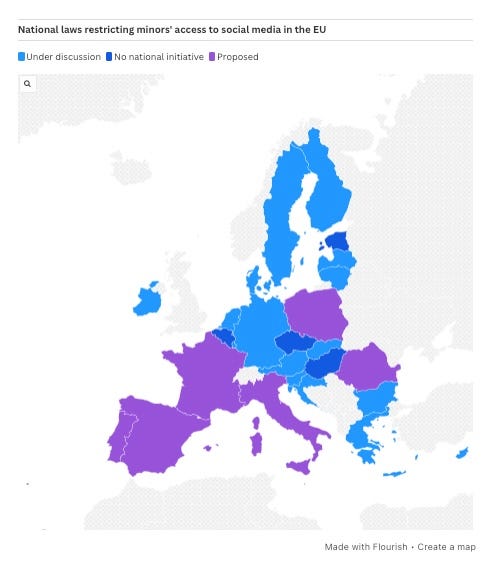
Critics of age verification warn that requiring every European to upload a passport, ID or facial scan to private companies would create serious privacy and security risks and erode online anonymity (see here, here, here, here, here). Moreover, a social media ban would probably not solve the very problems it is intended to address. On the contrary, according to children’s rights organisations, it is quite likely that such a restriction could drive children and young people into the darker and far more dangerous corners of the internet.
A European citizens’ initiative, “Stop Killing The Internet: No Digital ID & No Age Verification,” has now been launched to collect signatures against mandatory identity and age checks online. Organisers argue that protecting children must not mean identifying every internet user. The petition has one year to gather at least one million signatures across the EU so it can be submitted to the European Parliament and the Commission.
Iran War Puts Climate Crisis on Hold and Drives Global Coal Demand to Record High
The International Energy Agency (IEA) forecasts that global coal consumption will rise by 1.2 per cent this year, reaching a new record of 8.94 billion tonnes, even though the agency had previously predicted that demand for fossil fuels would fall. The agency cites the war in the Middle East, which has caused gas prices to rise, as the main reason for the growth in coal demand. A strong El Niño is also having an impact, as the weather has been warmer than usual and the resulting heavy use of air conditioning has increased coal consumption, reports The Telegraph.

“Although virtually no coal shipments pass through the Strait of Hormuz, the disruption has nonetheless affected coal markets by pushing up natural gas prices due to the plunge in liquefied natural gas shipments through the Strait,” the agency explained, adding that this has encouraged the use of coal-fired power stations in countries with a large number of gas-fired power stations and spare coal-generating capacity. Asian countries and many developing nations are contributing particularly significantly to coal demand, while the US has also sought to increase coal production in recent years.
“Although virtually no coal shipments pass through the Strait of Hormuz, the disruption has nonetheless affected coal markets by pushing up natural gas prices due to the plunge in liquefied natural gas shipments through the Strait,” the agency explained, adding that this has encouraged the use of coal-fired power stations in countries with a large number of gas-fired power stations and spare coal-generating capacity. Asian countries and many developing nations are contributing particularly significantly to coal demand, whilst the US has also sought to increase coal production in recent years.
But the IEA’s forecasts for coal demand go even further: the agency also predicts even greater demand next year if the Strait of Hormuz remains closed.
It is worth noting that producing one kilowatt-hour of energy from coal releases roughly one kilogram of CO₂, which is about twice as much as with gas. In other words, the war in the Middle East is putting the climate crisis on hold, even though there is a serious panic over reports that August was the hottest month in recorded history and that temperatures were 1.65 °C higher than in the pre-industrial era.
Antarctic Ice Sheet Has Been Gaining Ice Since 2020
According to a new study published in the journal Nature, satellite data show that the net loss of Antarctic ice slowed since 2016 and turned into a net gain since 2020. It is worth noting that since around the year 2000, it has been reported that the total mass of the Antarctic ice sheet has been decreasing, which has raised global sea levels.
Researchers used climate data and models to show why the Antarctic ice-mass trend recently reversed. The main reason is higher precipitation, which causes more snow and ice to accumulate on the surface. This increased precipitation is driven by stronger atmospheric rivers (ARs) and westerly winds, as well as reduced sea ice. Since 2020, these atmospheric rivers have become more frequent and intense, particularly on the Antarctic Peninsula and in Queen Maud Land and Wilkes Land, leading to a strong regional increase in ice mass. Surface mass balance (SMB) and atmospheric rivers (ARs) are greater in summer, especially on the Antarctic Peninsula and in the western Weddell Sea. In winter, SMB is higher along most of the Antarctic coastline, except West Antarctica.
Consequently, sea ice loss accounted for about 11 per cent of the recent winter increase in surface mass balance (about 3 per cent in summer). Overall, the rise in surface mass balance has been large enough to offset ongoing ice loss from discharge. According to the authors, this is not a short-term anomaly but the start of a significant mass-gain trend.