


Over the past few days, the following topics attracted our attention:
WHO Commission: Climate Crisis Is a Health Crisis
UNICEF: Online Age Verification Creates a False Sense of Security
Merkel: Social Media Must Be Censored
WHO Commission: Climate Crisis Is a Health Crisis
The Pan-European Commission on Climate and Health (PECCH) is calling on the World Health Organization (WHO) to “declare climate change a public health emergency of international concern.” The Commission believes that climate change is no longer a future environmental threat but rather an immediate and deepening crisis. This crisis is already affecting people’s health, food, water, energy, and security. Yet governments are not responding at the necessary level or with measures proportionate to the gravity of the situation, writes WHO.

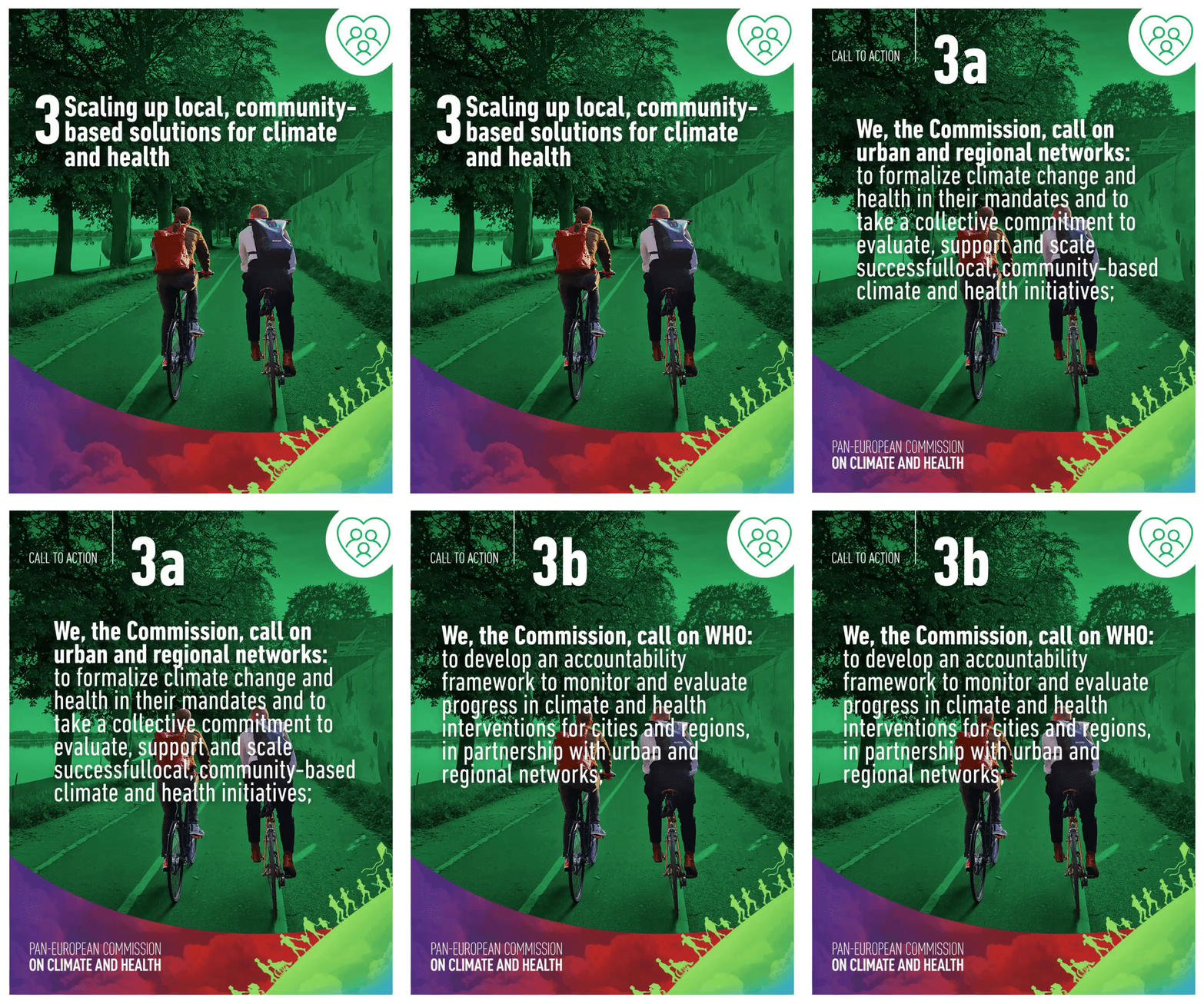
The Commission on Climate and Health, chaired by Iceland’s former Prime Minister Katrín Jakobsdóttir and comprising ministers, former heads of government, and representatives of key organizations from 53 countries, has therefore presented the WHO with 17 recommendations on what governments should do next. “The climate crisis is a threat to our safety and security, social cohesion, human rights, and health,” noted Commission Chair Jakobsdóttir, adding: “Far from being a problem solely for future generations, it is a real and present threat to us right now in Europe. Climate action is not merely a necessity. It is a high-return investment for a more just and resilient society. We all have a political and moral responsibility to act now.”
Among the Commission’s proposals are recommendations to treat climate change as a health security threat, make health systems more climate-resilient, scale up local action, and reform financial systems that continue to support fossil fuel use. The Commission calls on the WHO to designate climate change as “a public health emergency of international concern.” This is the highest level of health alert, as used, for example, during the COVID-19 crisis. In this way, the Commission hopes to trigger an international response to climate threats, including extreme heat, infectious diseases, food security, and air pollution.
One of the Commission’s main concerns is dependence on fossil fuels. Burning fossil fuels causes air pollution, climate change, and energy crises, which is why the Commission warns that oil and gas subsidies increase public health risks. However, if revenues from taxes were invested in wind and solar farms, public transportation, nutrition, and climate-resilient healthcare, it would save lives and reduce long-term costs.
In addition to calling for a phase-out of fossil fuels, the Commission argues that climate and health should be added to the agendas of national security councils, covering defense, energy, and finance ministries. The Commission appeals to the nations’ conscience, emphasizing that the geopolitical situation has led countries to spend increasingly more on security. Yet “climate change is itself a primary security risk; one that is already disrupting infrastructure, health systems and food and water security across the region, and one whose costs will compound with every year of delayed action.”
Therefore, the Commission finds that current international rules were designed for epidemics and are not suited for a climate health crisis, nor do they account for its scale. Since the WHO has not declared an official emergency, governments can treat climate change as a background factor rather than an acute and escalating threat. In this regard, the World Health Organization appears to largely agree, as Dr. Hans Henri P. Kluge, Regional Director for Europe, stated: “The case for acting on climate now is not just environmental. It is a security argument, a health argument, and an economic argument, all at once. And it is a moral imperative.”


At the same time, even the so-called mainstream of climate science has moved away from the most extreme climate scenario, according to which the world was supposed to warm by 4–5°C by 2100, leading to catastrophe. In other words, the abrupt climate change and impending catastrophe that were previously often highlighted in high-end projections are now considered less likely under updated scenarios.
UNICEF: Online Age Verification Creates a False Sense of Security
According to the children’s organization UNICEF, setting an age limit for online access does not effectively protect children from online risks, and it is not possible to
define a single “right age” for participating online, writes EU Perspectives.
Afrooz Kaviani Johnson, a child protection specialist at the organization, explained: “Evidence shows that risks and opportunities are shaped by factors such as digital literacy, parental support, and platform design — not age alone.” Moreover, older adolescents, rather than younger children, are more likely to encounter harmful content and exploitation. Children’s abilities also vary greatly even within the same age group. Therefore, Johnson warns that age restrictions can create a false sense of security. Instead of age limits and controls, what is needed is a safer digital environment for all children, including stronger protective measures on platforms, digital literacy programs, and greater accountability from technology companies.

UNICEF and Interpol’s studies confirm that social media platforms “remain a primary setting that facilitates online sexual abuse, by a significant margin, compared to other platforms.” New technologies, such as artificial intelligence, chatbots, and nudify apps, also pose risks of privacy breaches, manipulation, and exploitation, yet existing rules rarely apply to them. UNICEF data also confirms that harmful online experiences can lead to psychological consequences. A UNICEF report covering 21 countries found that children who have experienced sexual abuse or bullying online have higher levels of anxiety, more suicidal thoughts, and are more likely to self-harm.
Despite this, UNICEF emphasizes that social media is not uniformly harmful and that blanket restrictions are not the best solution. “For many children, social media provides support and connection,” said Johnson, adding: “For those who are isolated or marginalized, social media isn’t a luxury – it’s a lifeline.” For some young people, limited exposure to harmful content may improve their mental health, but for others, a sudden loss of connection can cause stress and isolation.
Furthermore, experts believe that age restrictions may shift responsibility from platforms to families and authorities, while failing to address harmful design. According to UNICEF, parents cannot fill this gap alone. Thus, UNICEF calls on governments to fulfill their fundamental obligation: “[R]edesigning platforms and policies around children’s rights and safety, and deploying rights-respecting age-assurance tools.”
The ECLAG (European Child Sexual Abuse Legislation Advocacy Group) shares a similar view, arguing that children’s rights must be placed at the center of discussions about children and their digital space. This includes the rights to safety, participation, inclusion, access to information, and privacy. However, current social media bans threaten to undermine all of these rights. Such plans conflate protection with restrictions. Instead of attempting to regulate children’s behaviour, the focus should be on the platforms and on seeking technologically neutral legislation.
Merkel: Social Media Must Be Censored
Former German Chancellor Angela Merkel delivered a speech at the award ceremony of the European Order of Merit on Tuesday. She urged the European Union to vigorously regulate social media and artificial intelligence. “To believe that responsibility for spreading information is no longer necessary, that accountability – there should be no accountability for lies – would undermine democracy,” Merkel said, according to the news portal Reclaim The Net.
In her speech, Angela Merkel warned that unregulated social media and artificial intelligence, along with misinformation and online lies, could threaten democracy by blurring the lines between truth and fiction. According to Merkel, social media creates an environment where “truth can be told as lies and lies can be told as truth.” This, in turn, threatens the information landscape across Europe, and artificial intelligence amplifies the problem. Therefore, Merkel called on the European Union to regulate social media – or rather, what social media should be – and artificial intelligence even more strictly. Merkel acknowledged that mistakes are indeed possible in this process, but that lessons will certainly be learned from them. In closing, she stated: “We’ve had 75 years of European thought. Peace, prosperity, and democracy.”
It is worth noting that it was Angela Merkel’s government that passed Germany’s NetzDG law in 2017. Under the law, platforms are required to remove “clearly illegal” content within 24 hours or face a fine of up to 50 million euros. But now, both opposition politicians and an increasing number of ordinary citizens have felt the law’s heavy hand (see here, here, here, here, here, here, here, here). By now, many other countries have followed the example of the NetzDG, such as Russia and Turkey, which have created their own definitions of “illegal” content.
The European Union has also built upon the concept created in Germany under Merkel’s leadership with its Digital Services Act (DSA). According to the DSA, large online platforms must assess and mitigate “systemic risks,” including curtailing the dissemination and visibility of information that is deemed to be hate speech or disinformation. The Committee on the Judiciary of the U.S. House of Representatives has called the DSA a sweeping censorship law.
The WHO negatively affects human health, food, water, energy, and security. It is an existential crisis. We need to declare an emergency of global concern to confront this threat now.
Im Agree with this quote:
There is no time in history, where the people who censoring speach been the good gays. RFK.JR