


Over the past couple of days, the following topics attracted our attention:
Instagram Is Phasing Out End-to-End Encryption for Chats
Belgian Media Council Reprimands 21News for Full JD Vance Speech
Australia Expands Scope of Age Verification
Instagram Is Phasing Out End-to-End Encryption for Chats
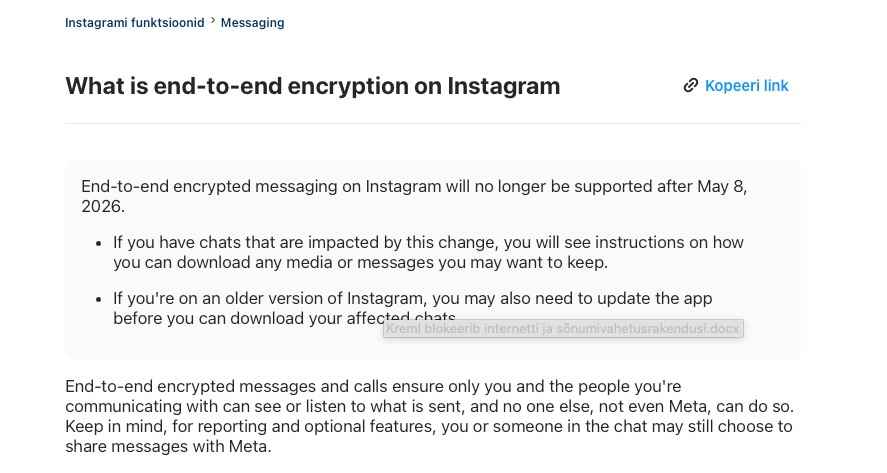
Instagram has published a notice on its Help Center page stating that, starting May 8, 2026, Instagram will no longer support end-to-end encrypted messaging. The page instructs users to download any affected chats or shared media they wish to keep, according to Proton.
Instagram has not explained why it plans to discontinue this support for end-to-end encryption, why such chats must be downloaded before the deadline, or what will happen to these chats after May 8. However, the notice clearly indicates that end-to-end encrypted messaging system will be discontinued. End-to-end encryption (E2EE) ensures message privacy, as messages can only be read by the devices involved in the conversation – not by the platform (including Meta), nor by hackers or governments.
Instagram’s parent company, Meta, has for years promoted encrypted messaging as a key feature of its services. Meta CEO Mark Zuckerberg announced in 2019 that he planned to implement encryption in all its messaging apps, namely Instagram, Messenger, and WhatsApp. At the time, Zuckerberg noted that people increasingly want digital spaces with private and secure conversations. As a result, Meta implemented end-to-end encryption in some of its messaging services. However, Meta spokesperson Dina El-Kassaby Luce has clarified that Instagram’s end-to-end encryption was optional and used by very few people. The spokesperson recommends using WhatsApp after May 8 if users want to send private messages.
The change on Instagram comes at a time when end-to-end encrypted messaging is often at the center of political debates. Around the world, authorities are increasingly pressuring social media platforms to “improve” their child safety features. In this context, E2EE is a main target, with demands for backdoors and feature weakening. For example, this year TikTok announced that it does not intend to encrypt chats, claiming the technology is controversial and puts users at risk. Child safety organizations and law enforcement agencies argue that E2EE makes it harder to stop the spread of harmful content online and to conduct certain investigations, since authorities cannot access private conversations. At the same time, privacy and cybersecurity experts warn of the opposite—weaker encryption puts billions of users at risk of surveillance, data leaks, and hacking.
Belgian Media Council Reprimands 21News for Full JD Vance Speech
The Ethics Commission of the French-language press in Belgium ruled that the Belgian right-wing news outlet 21News violated the journalistic code of ethics and the “cordon sanitaire médiatique” rule by publishing the full text of U.S. Vice President JD Vance’s speech delivered at the 2025 Munich Security Conference. The speech should have been fact-checked before publication and accompanied by explanations, such as noting that the speaker “represents a party that is anti-democratic,” according to Brussels Signal.
As you may recall, in his 2025 speech at the Munich security conference, JD Vance pointed out, among other things, that freedom of speech is declining across Europe and that the continent is struggling with problems caused by immigration.

In the Belgian Ethics Commission’s view, publishing this speech without commentary violated the Code of Ethics for the Media, particularly its provision on social responsibility. 21News should have included a statement that the U.S. Vice President “represented an anti-democratic and liberticidal party.” The outlet should also have used the time between the speech and its publication to verify Vance’s claims, add cross-references, and provide the “correct” context. Because 21News failed to do so, it had allowed “the individual to roll out their talking points and communication strategy without any distance or pushback.”
Thus, the Commission concluded that readers – or a portion of them – might have believed that JD Vance’s claims were accurate, even though the Commission considered many of them were racist or factually incorrect. “This carried the risk of turning the public against the functioning of European democracies or of inciting racism, discrimination, hatred or violence towards migrants,” the Commission stated.
21News responded that the Commission’s decision clearly demonstrates its paternalistic view of journalism, in which citizens should not be allowed to read political statements without filters. The outlet asked whether it is even possible to discuss anything in the French-language media anymore and added: “It [i.e. the speech] immediately provoked many reactions and discussions in Europe. We can judge this controversial discourse, be in deep disagreement with his analysis or his tone. But it is precisely for this reason that it is a significant document for relations between Europe and the United States.” 21News affirmed that it is neither for nor against the U.S. government, but believes that everyone must have the right to express their opinion and form one for themselves – especially at a time when trust in the media is low.

Australia Expands Scope of Age Verification
On December 10, 2025, a full ban on social media for those under 16 came into effect in Australia to protect children from its harmful effects. Many other countries, including the European Union, have begun to present Australia as an excellent example. However, the actual results do not confirm the “excellence” of the ban. Since it took effect, platforms in Australia have deactivated nearly 5 million youth accounts – that is, exactly that many children and young people are now barred from social networks, group chats, sports communities, and other social circles. All of this happens solely because the Canberra government decided so, not the parents, writes Consumer Choice Center.
However, preliminary data show that approximately 20% of Australian 13- to 15-year-olds still use social media platforms such as TikTok or Snapchat, often by using a VPN or some similar technology. Although the number of users in this age group did decline somewhat in January and February, the overall trend still points toward growth. The good news is that – at least so far – the fear that teenagers might migrate to unregulated platforms has not materialized. Only WhatsApp has recorded a slight increase in usage among 13–15-year-olds.

Australian authorities appear unconcerned that young people are not complying with the law. On the contrary, six new age-restriction requirements came into effect on March 9. Now many more internet services – such as artificial intelligence systems, app stores, search engines, and video games – must verify the age of all users to prevent access by those under 18. Australia requires these platforms to verify age using a person’s face, digital wallet, or photo ID. Consequently, even Australian adults must now prove their age almost everywhere online, including just to use a search engine or artificial intelligence.
Social media bans are justified in the same way everywhere: by citing the need to protect children and young people from harmful content and influences. Such claims are usually presented as a definitive scientific consensus. However, a study published in the journal JMIR Mental Health, for example, found insufficient evidence to support the claim that blanket social-media bans solve young people’s mental health problems. Instead, children can be cut off from vital support networks – especially, for example, for children with disabilities or other challenges. Young people also lose the opportunity to learn about and prepare for digital life. They are deprived of the tools, community, and parental guidance needed to navigate the digital world in the future.
According to the critics, Australia’s social media ban, now 100 days old, serves more as a warning than a model. Millions of children and young people have lost their social circles, yet officials cannot agree on what the law actually achieves. Further regulating the internet will not create a safer web, nor does forcing all the citizens to share personal data guarantee security. On the contrary, it puts everyone at greater risk of hacking and data breaches. At the same time, Australia continues to expand its surveillance infrastructure.